
Multi-Family Construction and Repair (MCR) Large Project Policies and Procedures
Downloadable PDF Version
Use the link below to open and download a PDF version of the current policies and procedures manual for the Multi-Family Construction and Repair (MCR) Large Project Program.
Revision History
| Version | Date | Description |
|---|---|---|
| 1.0 | December 1, 2025 | Initial version |
| 2.0 | June 17, 2026 |
|
| 2.1 | July 6, 2026 |
|
1. Overview
1.1 Introduction
Following the extensive damage caused by Hurricane Helene in September 2024, the U.S. Department of Housing and Urban Development (HUD) allocated $1,428,120,000 in Community Development Block Grant – Disaster Recovery (CDBG-DR) funding to the State of North Carolina (the State) under Public Law 118-158. This funding supports unmet needs and promotes resilient recovery in counties designated as the Most Impacted and Distressed (MID) areas.
To coordinate recovery and rebuilding across affected communities, the Governor directed the North Carolina Department of Commerce’s Division of Community Revitalization (DCR) as the lead agency. DCR is responsible for overseeing the State’s long-term recovery activities funded by CDBG-DR in response to Hurricane Helene. As part of the HUD-approved State Action Plan for the use of CDBG-DR funds, DCR established a suite of recovery programs to address major infrastructure and housing needs, including significant impacts to affordable rental housing. DCR’s housing programs include the Renew NC Single-Family Housing Program, the Renew NC Workforce Housing for Ownership Program, and the Multi-Family Construction and Repair Program (MCR). The MCR program is comprised of both small and large components. The small component is branded as the Renew NC Small Rental Rehabilitation Program.
1.2 Purpose of Policies and Procedures
This Policy and Procedure document is the primary resource for implementing the non-LIHTC track of large component of the MCR program (which is referred to as “MCR program” throughout this document). It is intended for use by applicants, developers, subrecipients, contractors, and other program stakeholders.
Specifically, this document:
- Defines eligibility criteria for applicants, sites, and activities.
- Describes the application, evaluation, and award process.
- Outlines program funding limits, underwriting, and affordability requirements.
- Establishes standards for environmental review, construction, and statutory compliance.
- Ensures adherence to all applicable federal and state regulations, including the 2025 Revised CDBG-DR Universal Notice under Annual which this allocation falls.
The contents of these policies and procedures are subject to revision based on HUD guidance, amendments to North Carolina’s Action Plan, or other factors.
1.3 Program Authority
The MCR program is governed by the following authorities and regulations:
- HUD’s 2025 Revised CDBG-DR Universal Notice;
- HUD Memorandum 25-02, issued March 19, 2025;
- The Housing and Community Development Act of 1974;
- The Disaster Relief Supplemental Appropriations Act, 2025 (Public Law 118-158, Division B, December 21, 2024);
- 24 CFR Part 570, including Subpart I for state-administered CDBG programs;
- 2 CFR Part 200, Uniform Administrative Requirements;
- Robert T. Stafford Act provisions;
- Any future or amended HUD guidance;
- Applicable federal environmental, labor, nondiscrimination, relocation, and fair housing regulations.
DCR, as the designated and lead administrator for the MCR program, will ensure compliance with all federal and state mandates and will manage program implementation, oversight, reporting, and monitoring.
1.4 Applicability
The policies and procedures in this manual apply to the non-LIHTC track of the large component of the MCR program, which aims to develop, rehabilitate, and preserve affordable multi-family rental housing in the HUD- and State-identified MID areas. A map and list of these areas, collectively called the combined MID area, is in Section 3.4.1 of this manual.
1.5 Program Overview
The small and large components of the MCR program have a total budget of $191,340,000. These funds support the construction, rehabilitation, or reconstruction of safe, sanitary, and affordable multi-family rental housing in areas impacted by Hurricane Helene. The large component of the MCR program is comprised of two tracks - Low Income Housing Tax Credits (LIHTC) and Non-Low Income Housing Tax Credits (Non-LIHTC). These policies address the non-LIHTC track. The LIHTC track is managed through a subrecipient agreement with the North Carolina Housing Finance Agency (NCHFA). Policies for the LIHTC track are available on DCR's website.
The large component of the MCR program may fund up to 100 percent of project costs, though priority will be given to projects that leverage additional funding sources. In accordance with HUD’s 2025 Revised Universal Notice, at least 80 percent of the CDBG-DR funds must benefit the HUD-identified MID areas, with up to 20 percent permitted for State-designated MID areas. Table 2 lists the HUD- and State-designated MID areas.
1.6 Storm Tie-Back and National Objective
All projects must demonstrate a clear direct or indirect tie-back to Hurricane Helene’s impacts, such as physical damage, increasing housing demand from displacement, or vulnerabilities exposed by the storm. Projects may also qualify as mitigation activities if they reduce long-term disaster risk and improve resilience.
Each activity must meet a CDBG-DR national objective under 24 CFR 570.483 and the 2025 Revised Universal Notice. The primary national objective for the large component of the MCR program is Low- and Moderate-Income Housing (LMH). Projects serving low- and moderate-income households must commit to a minimum 20-year affordability period.
1.7 Funding Structure
The large component of the MCR program has a budget of $133,940,000. DCR has elected to provide $60,000,000 of this budget to the North Carolina Housing Finance Agency (NCHFA) to expand the Low-Income Housing Tax Credits (LIHTC) available for eligible projects in eligible counties. This amount is subject to change based on applications received or other factors. Any updates will be reflected in future iterations of these policies and procedures.
Approximately $70,000,000 will fund the Non-LIHTC opportunities. These policies and procedures apply to these Non-LIHTC opportunities. Funding will be made available through a Notice of Funding Opportunity (NOFO) issued by DCR and published on the DCR website. Projects must demonstrate financial feasibility for the full affordability period, supported by a pro forma submitted with the application. Projects will also be encouraged to leverage outside funding, including other private or public capital. DCR may adjust award amounts based on funding availability, project feasibility, and alignment with program goals.
In addition, $18,600,000 has been set aside for mitigation purposes. Detailed application requirements will be provided in the NOFO.
1.8 Glossary of Terms
A glossary of terms used in these policies and procedures can be found on DCR’s website.
2. Program Administration
This section outlines how the Non-LIHTC program will be administered, including guidance for applicants on navigating the program and their responsibilities related to the program.
2.1 Roles and Responsibilities
The Non-LIHTC track is designed for multi-family projects that are not part of the LIHTC program. DCR will oversee this process, from publishing the NOFO, evaluating applications, underwriting, issuing awards, executing agreements, and monitoring long-term compliance. The Non-LIHTC track follows its own program rules, timelines, and scoring criteria, which are outlined in these policies and published in the program’s NOFO.
2.1.1 DCR Responsibilities
For all non-LIHTC projects, DCR is responsible for:
- Issuing the NOFO and application materials
- Managing the application intake, threshold review, scoring, and selection
- Conducting underwriting, subsidy layering, and duplication-of-benefit reviews
- Serving as the Responsible Entity for environmental review under 24 CFR Part 58
- Executing agreements and overseeing construction progress, financial draws, and compliance
- Monitoring affordability, rent limits, tenant eligibility, and all federal cross-cutting requirements throughout the compliance period
DCR may elect to utilize contractors for various tasks, including underwriting, environmental reviews, construction inspections, intake or outreach support, and financial or performance monitoring.
2.1.2 Applicant Responsibilities
Applicants to the program, such as developers and other subrecipients, are expected to:
- Submit complete and accurate applications;
- Demonstrate site control, financial capacity, and project feasibility;
- Adhere to all applicable program rules and regulations, including environmental, labor, accessibility, and fair housing requirements;
- Maintain accurate documentation and respond timely to monitoring requests; and
- Ensure timely and compliant lease-up, tenant eligibility verification, and rent setting.
3. Applicant and Project Eligibility
This section explains which types of projects and organizations are eligible to participate in the MCR program and outlines the key federal requirements that apply to all activities.
The MCR program’s goal is to support affordable, disaster-related, and eligible multi-family housing activities that advance long-term recovery from Hurricane Helene.
3.1 Meeting a CDBG-DR National Objective
All projects must meet a HUD national objective, as required by 24 CFR 570.483 and the 2025 Revised Universal Notice. For the MCR program, the primary national objective is Low- and Moderate-Income Housing (LMH). The Urgent Need (UN) national objective can be used with prior approval from DCR. Projects that fail to meet either the LMH or UN national objective are ineligible for the MCR program.
3.1.1 Low- and Moderate-Income Housing (LMH)
The requirements for the LMH national objective are found at 24 CFR 570.483(b)(3). For a project to qualify for the LMH national objective, at least 51 percent of the housing units must meet the following criteria:
- Occupied initially by a household at or below 80 percent of the area median income (AMI); and
- Units must be covered by a minimum 20-year affordability period, as required by the approved Action Plan
Income limits for CDBG-DR programs can be found online on the HUD Exchange.
To demonstrate a project will meet the LMH national objective, applicants to the non-LIHTC track will be asked to submit the following documentation as part of their application to DCR:
- Unit mix and rent schedule showing LMI unit compliance;
- Affordability Plan or land use restriction agreement (LURA);
- Development budget showing proportional application of CDBG-DR funds;
- Initial and ongoing income verification procedures.
For projects where more than 20 percent but less than 51 percent of the units are occupied by low- and moderate-income households, CDBG-DR assistance may be provided proportionately to ensure that the project costs borne by the CDBG-DR award is no greater than the proportion of units in the project that will be occupied by low- and moderate-income households, with clear documentation of cost allocation.
3.1.2 Urgent Need (UN)
In limited circumstances, pre-approved by DCR, projects may qualify under the Urgent Need (UN) national objective, where:
- The project directly addresses a documented disaster-related impact, such as the loss of housing stock due to Hurricane Helene;
- LMI occupancy is not feasible or practical based on the project location, population served, or other demonstrated conditions; and
- The project can be said to alleviate conditions that pose a serious and immediate threat to the health and welfare of the community.
To qualify under the UN national objective, applicants to the non-LIHTC track must request advance approval from DCR as a threshold eligibility determination. This determination is separate from and must occur before the project is considered in the competitive scoring and selection process. Projects seeking to use UN instead of LMH may receive a lower priority during evaluation unless they address a critical gap in recovery. To demonstrate a project will meet the UN national objective, applicants to the non-LIHTC track will be asked to submit the following documentation as part of their application to DCR:
- Written justification of the urgent need tied to Hurricane Helene’s impacts;
- Certification that the condition poses a serious and immediate threat;
- Documentation that no other financial resources are available.
3.2 Avoiding Duplicated Benefits
CDBG-DR is the funding of last resort. During the application process, all applicants must disclose any assistance received for the same purpose, including insurance, FEMA, SBA, US Army Corps of Engineers, LIHTC equity, other federal funds, state or local funds, or philanthropic sources, and provide supporting documentation related to the assistance. Applicants will also be required to sign a Subrogation Agreement and a duplication of benefits (DOB) certification prior to award.
The program will define total development costs as the applicant’s total need and will compare other assistance the applicant has received against this total need to determine the unmet need. Any assistance received above the total need will be considered a DOB. If a DOB is identified at any point, the funding awarded will be adjusted accordingly and in compliance with federal requirements. Failure to disclose or misrepresenting information can result in denial of funding, repayment, or further investigation.
See DCR’s Duplication of Benefits Policy for additional information on the DOB process for rehabilitation and new construction activities.
3.2.1 Offsetting Awards and Monitoring
If duplicative funds are received after an award is made, the applicant must report the funds, in writing, to DCR within 15 calendar days of receipt. The award amount will be adjusted downward accordingly to reflect the reduced unmet need, or the applicant will be required to return any duplicative assistance to DCR.
DCR will monitor projects for DOB compliance throughout the program lifecycle. This includes:
- Periodic file reviews during implementation to detect any newly disclosed or previously unreported sources of assistance;
- Cross-checking data against FEMA, SBA, US Army Corps of Engineers, insurance, and other federal/state/local sources to verify compliance;
- Follow-up communication with applicants when potential duplications arise.
3.3 Eligible Applicants
The MCR program welcomes a wide range of applicant types, provided they demonstrate the ability to successfully develop and maintain affordable housing.
Eligible applicants include but are not limited to:
- For-profit developers
- Joint ventures between eligible entities above, provided they demonstrate adequate development capacity and financial management acumen
- Non-profit housing developers, including Community Housing Development Organizations (CHDOs) and Community-Based Development Organizations (CBDOs)
- Public housing authorities
- Units of local government
Applicants must:
- Be legally organized to develop and operate multi-family rental housing
- Have experience delivering publicly funded affordable housing
- Be in good legal and financial standing with federal and state agencies
- Not be debarred or suspended
Awarded applications will be managed as either subrecipients or developers, based on the CDBG-DR Partner Role Assessment and Development Agreement Checklist on the HUD Exchange, which is summarized below in Table 1.
| Criteria | Subrecipient | Developer |
|---|---|---|
| Must be competitively procured? | No but grantees should follow a documented process for selecting subrecipients and must conduct a risk assessment of each subrecipient to determine monitoring and technical assistance needs. State or local rules may require procurement. | No but developers should be selected based on an evaluation of capacity, quality and cost. For CDBG and CDBG-DR, developers should also be identified in the action plan as eligible beneficiaries for a particular program and grantee policies and procedures should specify the criteria for providing awards to developers as beneficiaries. |
| Required to follow procurement? | Yes | No |
| Allowable entity types | Must be public agency or nonprofit (for-profit entities may only be subrecipients if undertaking economic development activities under 24 CFR 570.201(o)) | May be for-profit or nonprofit but must be a private entity to be eligible for assistance under 24 CFR 570.202(b)(1) |
| Type of legal instrument | Subrecipient agreement | Developer agreement |
| Can incur activity delivery costs? | Yes | No |
| Can incur admin and planning costs? | Yes, subject to program caps and grantee policies | No |
| Can earn profit? | No | May earn Developer's fee under 24 CFR 570.202(b)(1) in exchange for assuming some financial risk in the project |
| Revenue/program income | Must treat excess revenues as program income and return to grantee, or if the grantee permits, subrecipients may keep program income to implement other eligible activities. | Not required to return excess revenues. However, HUD strongly encourages grantees to implement mechanisms which prevent undue enrichment. |
| Subject to cost principles? |
| Not applicable but cost reasonableness must still be documented |
| Must have site control? | Yes, if directly implementing activities | Yes |
| Assumes financial risk in project? | Subrecipients are not required to assume financial risk in a project, as they are compensated with HUD funds for actual project costs. However, subrecipients may invest additional funds if they choose. | Yes |
3.3.1 Citizen Participation Requirements for Local Government Applicants
To meet the minimum requirements for citizen participation, local government applicants must hold two public hearings to obtain citizens’ comments, at least one of which must be held prior to submitting an application. The notice of such public hearing must be published at least 10 days but no more than 25 days before the date of the hearing. Notice must be published on the local government's website as well as at least one additional method to ensure wide participation.
Examples include posting in the non-legal section of the newspaper with general circulation in the area, social media accounts, radio ads, and distribution lists. The notice must state the types of projects to be undertaken, the source and amount of funding available for the activities, the date by which comments must be made, and a contact person for a copy of the proposed application. The application will require documented evidence of properly noticed meetings; an affidavit may be submitted but is not required. Applicants must also provide for a 10-day comment period, which must close prior to the submission of the application.
3.4 Eligibility Criteria
To qualify for the MCR program, properties must meet several location and readiness requirements.
3.4.1 Location in a MID Area
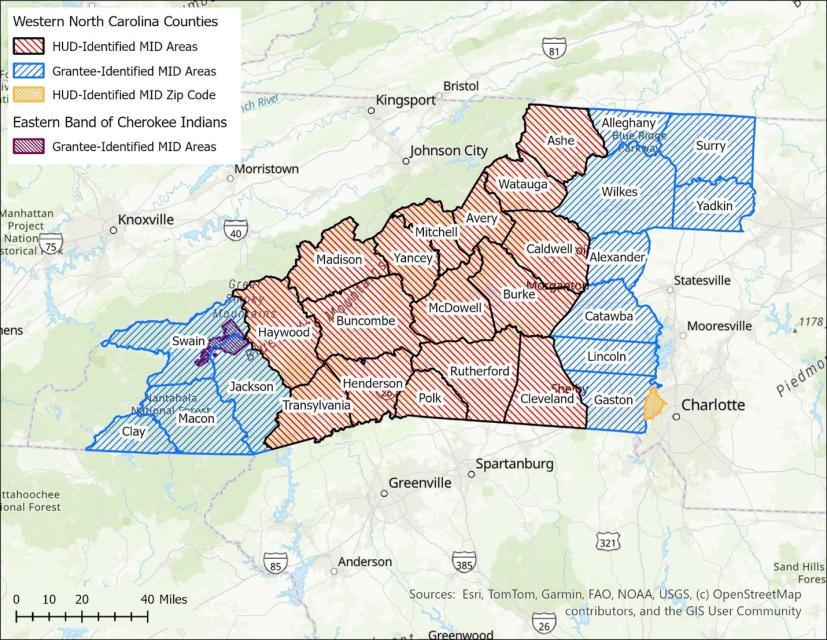
Properties must be located in a HUD-identified or State-identified Most Impacted and Distressed (MID) area. These combined MID areas are shown in Table 2 and Figure 1 below.
| County | HUD or State MID |
|---|---|
| Alexander | State MID |
| Alleghany | State MID |
| Ashe | HUD MID |
| Avery | HUD MID |
| Buncombe | HUD MID |
| Burke | HUD MID |
| Caldwell | HUD MID |
| Catawba | State MID |
| Clay | State MID |
| Cleveland | HUD MID |
| Gaston | State MID |
| Haywood | HUD MID |
| Henderson | HUD MID |
| Jackson | State MID |
| Lincoln | State MID |
| Macon | State MID |
| Madison | HUD MID |
| McDowell | HUD MID |
| Mecklenburg (zip code 8214 only) | HUD MID |
| Mitchell | HUD MID |
| Polk | HUD MID |
| Rutherford | HUD MID |
| Surry | State MID |
| Swain | State MID |
| Transylvania | HUD MID |
| Watauga | HUD MID |
| Wilkes | State MID |
| Yadkin | State MID |
| Yancey | HUD MID |
3.4.2 Project Eligibility
Projects must:
- Include five (5) or more rental units under common ownership and management;
- Be located in an eligible area (see section 3.4.1);
- Must be constructed to mitigate the impact of likely future disasters in accordance with State and local codes, ordinances, and requirements;
- Must meet the accessibility requirements of 24 CFR Part 8, which implements section 504 of the Rehabilitation Act of 1973 (29 U.S.C. § 794), and Titles II and III of the Americans with Disabilities Act (42 U.S.C. 12131-12189) implemented at 28 CFR parts 35 and 36, as applicable. Covered multi-family dwellings, as defined at 24 CFR 100.201, must also meet the design and construction requirements at 24 CFR 100.205, which implements the Fair Housing Act (42 U.S.C. § 3601-3619);
- Newly constructed housing shall qualify as affordable housing under this part only if it meets the energy efficiency standards promulgated by the Secretary in accordance with section 109 of the Cranston-Gonzalez National Affordable Housing Act (42 U.S.C. § 12709);
- Construction must include installation of broadband infrastructure, as applicable and as this term is defined in 24 CFR 5.100, unless a waiver is granted by DCR. A waiver may be considered if the cost of installing broadband would result in a fundamental alteration in the nature of the project or activity, create an undue financial burden, or if the structure or location makes installation infeasible;
- Address an unmet need related to Hurricane Helene (e.g., replacement of units damaged or destroyed by the storm; expansion of affordable rental housing supply to accommodate displaced households; or redevelopment in neighborhoods experiencing post-disaster affordable housing shortage);
- Demonstrate a clear relationship (“tie-back”) to the impacts of Hurricane Helene. This can be demonstrated directly or indirectly through documented storm damage, increased housing demand from storm-related displacement, vulnerabilities revealed or worsened by the disaster, or a resilience or mitigation activity that reduces risk in future events. Tie-back must be supported by reliable sources such as damage assessments, FEMA information, insurance records, or other official data;
- Be covered by a minimum 20-year affordability and restrictive use period consistent with requirements established by the Action Plan.
3.4.3 Site Feasibility
Sites must be suitable for residential development and meet legal and zoning requirements prior to funding award or project initiation. Specifically:
- Zoning and Land Use: Sites must be zoned for multi-family residential use or demonstrate a clear path to rezoning approval within 90 days of conditional award.
- Infrastructure Access: Preference will be given for sites with access to public water and sanitary sewer, broadband, public roadways or easements sufficient for site access, and other public utilities necessary to support residential occupancy. Projects seeking off-site improvements must identify funding for and responsible parties to achieve acceptable public utility extensions to a specified site.
- Site Control: Applicants must demonstrate site control through ownership, long-term lease (minimum term equal to the affordability period), or an executed purchase agreement or option contract that remains valid for at least 90 days beyond the application deadline. Purchase options or agreements cannot specify CDBG-DR as a firm funding source and should utilize the language provided by HUD to avoid concerns related to choice-limiting actions.
3.4.4 Environmental Review
All sites are subject to environmental review under 24 CFR Part 58. The purpose of the environmental review is to ensure that proposed projects do not negatively affect the environment (natural and human) and that environmental conditions do not jeopardize the safety and health of project residents.
Projects may not be located in an airport runway clear zone, or on sites with known toxins/severe contamination. All development activity must occur outside of the preliminary or effective floodway or a non-encroachment area. Additionally, development activity should occur outside the HUD-defined Federal Flood Risk Management Standard (FFRMS) flood zone. Properties within the FFRMS floodplain must implement appropriate mitigation, or may be deemed ineligible. As part of the environmental review, projects that involve historic structures must comply with Section 106 of the National Historic Preservation Act.
During the environmental review, DCR will serve as the Responsible Entity. In this role, DCR will:
- Complete all required environmental reviews;
- Publish and distribute public notices as required;
- Maintain the Environmental Review Record (ERR);
- Prepare as needed the Request for Release of Funds (RROF);
- Verify that no choice limiting actions have occurred prior to the Authorization to Use Grant Funds (AUGF) is received; and
- Ensure that projects do not proceed until environmental clearance is issued.
In limited cases, DCR may delegate certain environmental review responsibilities or adopt environmental reviews conducted by other authorized local governments or state agencies, where permitted under 24 CFR Part 58. Any such delegation will be documented through a written agreement (e.g., Memorandum of Understanding or Interagency Agreement) that clearly outlines roles and responsibilities. Regardless of delegation, DCR remains the Responsible Entity and retains ultimate responsibility for ensuring compliance with NEPA and all applicable federal and state environmental requirements.
Environmental reviews will cover but not be limited to:
- Site topography and soil conditions.
- Hazardous materials and contamination concerns.
- Compatibility with surrounding land uses.
- Whether any prohibited “Choice-Limiting Actions” occurred before environmental clearance and the issuance of a formal Notice to Proceed.
Common Choice-Limiting Actions include:
- Acquisition of real property.
- Executing binding leases or long-term options.
- Site preparation or ground disturbance.
- Construction, rehabilitation, or demolition activities.
- Disbursement of funds or financial commitments tied to development.
Any Choice-Limiting Actions taken before completion of environmental clearance may result in project disqualification, ineligibility of all pre-agreement costs for reimbursement, or potential cancellation of project funding.
DCR will verify compliance through application documentation and environmental review records.
3.4.4.1 Scope of Environmental Review
Depending on the nature and location of the project, the environmental review may examine a range of potential impacts. These include, but are not limited to, compliance with historic preservation laws, such as Section 106 of the National Historic Preservation Act; evaluation of floodplain and wetlands risks in accordance with applicable Executive Orders; and the presence of hazardous materials or contamination, including proximity to toxic or explosive sites and the suitability of soils. The review may also consider land use compatibility, including zoning, siting, and conformance with local and regional plans, as well as the project’s impact on infrastructure and public services, such as water and sewer systems, stormwater drainage, transportation access, and emergency response capacity. In addition, reviewers will assess socioeconomic and demographic impacts, including the potential for displacement and compliance with environmental justice principles.
Finally, the environmental review may address impacts on natural resources and ecosystems, including air and noise quality, endangered species, and protected habitats. All reviews will be conducted in accordance with 24 CFR Part 58 and HUD environmental assessment guidance, including Form HUD-4128 where applicable.
Projects located in the FFRMS floodplain will require documentation of flood mitigation compliance per 24 CFR Part 55, and may require elevation, flood insurance, or alternative siting. Minimum flood insurance requirements are governed by applicable federal, state, local, and tribal laws and regulations related to both flood insurance and floodplain management, and are set forth in HUD’s 2025 Revised Universal Notice at Section III.B.11.a.
3.4.4.2 Environmental Conditions for Approval
As a condition of receiving CDBG-DR assistance, project sponsors must cooperate fully with environmental review staff, provide all necessary site documentation and studies, and comply with any mitigation or remediation measures identified through the environmental review process. Environmental clearance must be secured before the project reaches the point of federal commitment, including final award and any disbursement of funds.
3.4.5 Displacement and Relocation
If the project involves the acquisition, redevelopment, or demolition of an occupied property, applicants must comply with the Uniform Relocation Assistance and Real Property Acquisition Act (URA). Applicants will be required to provide appropriate relocation benefits and related services that comply with the URA and DCR’s CDBG-DR Residential Anti-Displacement and Relocation Assistance Plan (RARAP), which intends to minimize displacement. In instances where displacement occurs, applicants will be provided with technical assistance to ensure that the rights of any displaced person, as defined by 24 CFR 570.606 (b)(2), are upheld. Should any displaced person have accessibility needs, the advisory services they receive as required by the URA will meet those needs.
3.5 Eligible Activities
MCR may fund a wide range of eligible multi-family development activities, in accordance with Title I of the Housing and Community Development Act of 1974 (42 USC 5305(a)) and the 2025 Revised Universal Notice, such as:
- § 5305(a)(1) – Acquisition
- § 5305(a)(3) – Code Enforcement
- § 5305(a)(4) – Clearance, Rehabilitation, Reconstruction and Construction of Buildings, including housing
- § 5305(a)(5) – Removal of Architectural Barriers
- § 5305(a)(7) – Disposition
- § 5305(a)(8) – Public Services
- § 5305(a)(11) – Relocation Payments
- § 5305(a)(13) – Administrative Costs
- § 5305(a)(14) – Assistance to Non-Profit Entities
- § 5305(a)(15) – Assistance to Neighborhood-Based Organizations
- § 5305(a)(20) – Housing Services
- § 5305(a)(24) – Direct Assistance for Homeownership Activities
- § 5305(a)(25) – Tornado Shelters
- § 5305(a)(26) – Lead-Based Paint Hazard Evaluation and Reduction
- Universal Notice – Housing Activities and New Housing Construction - Sections III.D.5 and III.D.5a
- Universal Notice – Mitigation – Sections III.D., III.D.4, and III.D.4a
3.6 Ineligible Activities
Costs that are not clearly related to eligible activities and costs described above are deemed ineligible for MCR program funding. Ineligible activities are defined in 24 CFR 570.207.
The following is a non-exhaustive list of examples of ineligible costs and activities:
- Costs incurred prior to environmental clearance.
- Luxury improvements not essential to health and safety (e.g., swimming pools, high-end finishes, etc.).
- Commercial components not allocated to a non-CDBG-DR source.
- Operating reserves or rental subsidies.
- Political, lobbying, or legal fees unrelated to program delivery.
- Costs in excess of allowable per-unit subsidy limits, as established by DCR in alignment with HUD guidelines.
There are certain areas where development is ineligible for program funding. These include:
- FEMA-designated preliminary or effective regulatory floodways or Special Flood Hazard Area (SFHA);
- Non-encroachment areas.
3.7 Affordability Requirements
3.7.1 Affordability Period
All assisted units must remain affordable for at least 20 years, enforced by a recorded Land Use Restriction Agreement (LURA). The affordability period begins once the project is complete and a Certificate of Occupancy (or other similar documentation, subject to DCR approval) has been issued.
3.7.2 Income Targeting
Assisted units must serve households at or below 80 percent Area Median Income (AMI). Deeper targets may be established in the NOFO. Households must be income-verified at initial occupancy/lease-up and recertified annually in accordance with HUD guidance.
Project owners/sponsors will be responsible for providing DCR with an update on each annual recertification process, and DCR may impose corrective actions if the project is out of compliance with the applicable standard.
3.7.3 Rent Limits
Rents must not exceed HUD’s High HOME rent limits, which are published annually on HUD’s website. Rents must include utilities, or utility allowances (as discussed below) must be factored in accordance with HUD regulations to determine tenant rent.
All rent increases during the affordability period must be reviewed by DCR in advance. Property owners will be expected to submit a written request to DCR at least 60 days before the proposed effective date of the rent change. The request must include:
- Current and proposed rent schedule;
- Updated utility allowance documentation;
- Justification for the change (e.g., increased operating costs or changes in HUD limits);
- Certification that the proposed rents remain under the applicable rent cap.
DCR will review the request to ensure that it complies with HUD High HOME Rent Limits or alternative caps, proper application of utility allowances, and continued compliance with affordability requirements. DCR will issue a written decision within 30 days of receipt. No rent increases may be implemented without written approval.
3.7.4 Utility Allowance
Under HUD regulations and the 2025 Revised Universal Notice, gross rent includes both the contract rent paid to the owner and any tenant-paid utilities. If tenants are responsible for paying utilities separately, the rent charged must be reduced by an approved utility allowance to ensure that the gross rent does not exceed the applicable rent limits.
A utility allowance must be based on a HUD-approved methodology. The MCR program permits two options:
- Public Housing Authority (PHA) Utility Allowance Schedule – Developers may use the most recent utility allowance schedule published by the PHA for the project's jurisdiction. These schedules are:
- Typically based on the Section 8 Housing Choice Voucher methodology;
- Tailored by unit size, building type, and utility source (e.g., gas vs. electric heating);
- Updated annually by the PHA.
- To use the PHA schedule, the project’s unit characteristics must match those assumed in the PHA’s methodology (e.g., number of bedrooms, energy type, appliance efficiency).
- Project-Specific Utility Allowance (PSUA) – Alternatively, a project may submit a project-specific utility allowance (PSUA). This must be:
- Developed by a qualified energy analyst, engineer, or utility professional;
- Based on actual or anticipated consumption patterns for the specific development;
- Accompanied by documented assumptions and calculations supporting the methodology.
The PSUA must be submitted to DCR for review and approval before lease-up. Projects that apply unapproved or inaccurate utility allowances may be found to be out of compliance. This could result in tenant overcharging and may trigger payments of CDBG-DR funds.
3.8 Ongoing Compliance
Properties must maintain documentation of tenant eligibility, rental compliance, and unit occupancy throughout the affordability period. DCR or its designee will monitor these requirements annually. Noncompliance may require corrective action or repayment.
Property owners must:
- Maintain documentation verifying:
- Tenant income eligibility at initial occupancy and during annual recertification;
- Affordable rent limits as defined in Section 3.7.3
- Lease-up records, showing adherence to fair housing and occupancy requirements.
- Submit annual compliance reports to DCR, or its designee, including:
- Current tenant household income levels;
- Unit rent levels and utility allowances;
- Occupancy status and any changes during the reporting period;
- Updates regarding changes in financing related to the property.
4. Application Process
DCR will issue a Notice of Funding Opportunity (NOFO) to announce the application’s requirements, deadlines, and scoring criteria. Applications to the program will be evaluated and scored competitively, and selected applications will undergo underwriting and environmental review before funds are fully committed. This section provides an overview of the application process.
4.1 Prescreening
Prior to the application submission cycle opening, a prescreening for project planning and technical assistance will be available. This prescreening for project planning is not required. Pre-screening is meant to help DCR assess unmet need and to assist potential applicants in understanding whether a proposed project will meet threshold requirements and whether an applicant has the organizational capacity and experience to manage funds.
This process will remain open and can be utilized before, during, and after the application window.
Submitting a pre-screen is not submitting an application for assistance. DCR expects that submitting the application will federalize the project for which the applicant is applying, after which it will be subject to all applicable federal cross-cutting requirements. Once a project is federalized, the applicant may not undertake any choice-limiting actions, including acquisition, demolition, construction, or rehabilitation, until the required environmental review has been completed. The applicant must also comply with all applicable federal procurement requirements, labor standards, and nondiscrimination, relocation, and accessibility requirements. DCR recommends consulting with MCR program staff prior to submitting a formal application.
4.2 Notice of Funding Opportunity (NOFO)
DCR will implement the MCR program through the release of an NOFO. DCR will publish a public notice announcing the program and available funding, and request applications through DCR’s social media accounts, website, press releases and other public channels.
DCR anticipates releasing one NOFO for this program, which will make $70,591,500 available for eligible applicants and projects. It will outline:
- Available funding for the round;
- Eligible applicants and activities;
- Application instructions and deadlines;
- Threshold requirements and award limits;
- Program priorities; and
- Evaluation and scoring methodology
The NOFO will invite competitive applications for large multi-family housing developments, defined as projects consisting of five or more rental units. DCR will use a scoring-based application review to ensure awards are made to projects that demonstrate the greatest potential to support long-term recovery and housing resilience in disaster-affected areas.
DCR may release additional NOFOs based on factors such as:
- Remaining funding availability.
- The results of ongoing unmet needs assessments.
- Geographic or market coverage gaps.
- The overall volume and readiness of submitted projects.
Any subsequent NOFO will clearly articulate updated goals, timelines, and selection criteria in line with emerging recovery priorities.
4.3 Program Priorities and Application Submission Requirements
While all eligible projects may apply under the initial NOFO, the MCR program will prioritize developments that are located in:
- HUD-Identified Most Impacted and Distressed (MID) areas, as opposed to State MID areas;
- Qualified Census Tracts (QCTs); or
- Difficult Development Areas (DDAs).
Targeting CDBG-DR funding to these areas will support recovery and ensure resources are directed to communities with demonstrated need and high potential for impact.
Once applications are received, DCR will first evaluate applications for threshold eligibility and completeness, including:
- Eligible applicant and entity type
- National Objective
- Location in a combined MID area
- Tie-back to Helene
- Minimum project size (5 units or more under common ownership and management)
- Experience developing and/or managing publicly funded housing projects
- Preliminary financial feasibility
- Project must not be located in a regulatory floodway, floodplain, or non-encroachment area
Applications that fail the threshold review do not proceed to scoring.
The NOFO will outline what constitutes a complete application. Applicants should expect to complete a full application form and provide all requested supporting materials. Additional components of a complete application will likely include:
- Project narrative, articulating tie-back to Hurricane Helene and alignment with program goals
- Development budget and sources/uses, outlining preliminary estimates with identified/anticipated funding sources
- Pro forma for full twenty (20) year affordability period
- Preliminary site plan and building design, if available, including unit mix and lay out
- Organizational experience and capacity with multi-family housing, including a narrative and resumes of key development staff
- Project schedule showing milestones from award through completion
- Zoning documentation, including proof of current multi-family zoning or path to approval
- Site control documentation, such as a deed, long-term lease, or purchase option for the site
- Environmental and other risk information, including known site conditions, information about FEMA flood zones, and other potential hazards
- Financial evaluation, including the applicants’ most recent financial audit
The NOFO will clearly outline when applications are due. Any late or incomplete submissions will not be considered. DCR reserves the right to request minor clarifications or administrative corrections from applicants, provided such updates do not materially affect eligibility or scoring.
4.4 Competitive Scoring
Eligible applications are scored based on criteria published in the NOFO, which will assess project impact, readiness, cost reasonableness and leveraging of other financial sources, feasibility, and alignment with program goals and recovery priorities.
Each of these five major scoring factors will be assigned a weighted average. Subfactors within each major factor will be assigned, and applicants will receive points based on their performance against these subfactors. Scoring may be awarded proportionally based on the extent to which an application meets each criterion.
Top-scoring applications may receive conditional awards, subject to underwriting and environmental clearance.
4.4.1 Capacity of Applicant (10 points)
This criterion will evaluate the qualifications, experience, and organizational infrastructure of the applicant and its development team. Applicants are encouraged to use this section to demonstrate their ability to manage all aspects of the program. Applicants may be able to discuss prior successful projects, experience with similar funding sources, financial and staff capacity to oversee construction, compliance and reporting, and demonstrated ability to deliver projects on time and within budget.
4.4.2 Community Need for Multi-Family Housing (20 points)
This factor measures the degree to which the proposed project responds to a critical unmet housing need. Applicants may demonstrate this by providing documented shortages of affordable rental housing, the project’s alignment with recovery priorities outlined in the NOFO, project location in a priority area, or alignment with local recovery or housing plans.
4.4.3 Soundness of Approach (40 points)
This factor is the highest-weighted scoring category and assesses the overall viability and completeness of the application. It may consider factors such as site readiness, project design, realistic cost estimates, reasonable project timelines, a strong plan for construction management and oversight. Additionally, all projects must adhere to the Uniform Relocation Assistance and Real Property Acquisition Policies Act of 1970, as amended, when applicable. Applicants should demonstrate their understanding of how the URA will apply to their project and discuss how their project will comply with the URA, as appropriate.
4.4.4 Leverage of Other Resources (20 points)
This criterion evaluates the extent to which the applicant brings non-CDBG-DR funds to the project. Leverage demonstrates financial commitment and enhances the efficiency of the CDBG-DR investment. Leveraged sources may include but are not limited to private financing, philanthropic or local government contributions, in-kind contributions, or other public funds.
4.4.5 Achieving Results (10 points)
This category will assess the anticipated outcomes of the project and its long-term benefits. Factors may include the number and type of affordable housing units created or preserved, units dedicated to populations with access or functional needs, and the integration of supportive services or partnerships that enhance housing outcomes, such as resident services, workforce development, or coordination with health and/or social services.
4.4.6 Bonus Considerations
DCR may allocate additional points to applications based on certain factors, such as:
- Targeting affordability requirements below the program requirement of 80 percent AMI (+10 points)
- Enhanced mitigation or resilience features, such as Green Building Standards or Energy STAR features (+5 points)
- Length of affordability beyond the program requirements of 20 years (+10 points)
- Are located in geographic areas that are underrepresented (+20 points)
- Include enhanced accessibility features such as wider doorways, or supportive services for persons with disabilities or elderly residents beyond what is legally required (+5 points)
- Leveraging HUD’s Rapid Unsheltered Survivor Housing (RUSH) grants (+3 points)
5. Underwriting and Compliance Determinations
Underwriting is a critical step in the MCR program, ensuring each awarded project is financially feasible, cost-reasonable, aligned with program objectives, and structured to remain stable and affordable for the full required twenty-year affordability period.
5.1 Purpose of Underwriting
The purpose of underwriting is to evaluate whether a project is financially sound and capable of achieving the program’s goals. During the underwriting process, DCR will assess the project’s financial feasibility, cost structure, operating assumptions, development timeline, and overall risk profile.
5.2 Underwriting Process
DCR conducts the complete underwriting review and is responsible for ensuring that each application is both financially feasible and fully compliant with CDBG-DR requirements. During this evaluation, DCR reviews the development’s construction budget, soft costs, developer fee, builder profit, proposed financing package, and long-term operating assumptions. The review includes the confirmation that projected rents are sustainable, that operating expenses are reasonable for the market, and that adequate operating and replacement reserves are planned. DCR also assesses the project’s readiness, including the status of zoning, permitting, site control, and any identified environmental or acquisition risks.
A central component of the underwriting process is the verification that CDBG-DR funds are necessary and not excessive. To meet this requirement, DCR performs a subsidy layering review, examining all committed and anticipated sources of financing to ensure consistency with cost reasonableness benchmarks. The review also confirms that the share of CDBG-DR funding aligns proportionally with the number of income-restricted units and that the project’s financing plan supports the long-term affordability without undue reliance on future subsidies.
DCR further evaluates the project’s ability to comply with cross-cutting requirements, including the Uniform Relocation Assistance and Real Property Acquisition Policies Act (URA) where applicable, the integration of environmental mitigation measures identified in the environmental review, labor standards, Section 3, and the project’s plan for meeting federal accessibility and fair housing standards. These considerations help ensure that funded developments will operate safely, reliably, and equitably for their residents. Table 3 outlines specific underwriting criteria.
| Underwriting Criterion | Description |
|---|---|
| Financial Feasibility Requirements | Evaluates the project’s financial viability over time based on income, expenses, rent levels, reserves, and stabilization period. |
| Total Development Costs (TDC) Reasonableness | Assesses whether overall project costs are aligned with market norms (e.g., cost per unit, per square foot) and justifiable. |
| Subsidy Layering and Cost Reasonableness | Ensures MCR funds are the minimum necessary and do not duplicate other public funding; compared against industry benchmarks. |
| Developer Fee, Builder Profit, and Overhead Caps | Enforces caps on developer fees and construction overhead to ensure costs are fair and aligned with program limits. |
| Sources and Uses Analysis | Verifies all funding sources and ensures use of funds matches program eligibility; confirms leverage and gap coverage. |
| Match and Leveraging Documentation | Reviews third-party commitments and contributions to confirm enforceability, timing, and sufficiency of matching funds. |
| Operating and Replacement Reserves | Confirms the establishment of appropriate operating and capital reserves to support long-term property health. |
| Operating Pro Forma | Evaluates projected operating income, expenses, and reserve contributions across the affordability period. |
| Affordability and Rent Limits Compliance | Confirms compliance with HOME rent limits and affordability period; ensures income targeting is accurate and sustainable. |
| Mitigation and Resilience Cost Integration | Ensures proposed costs for hazard mitigation or resilience are necessary, eligible, and cost-reasonable. |
| Project Timeline and Readiness | Reviews milestone timelines, permitting readiness, and potential development delays that could impact feasibility. |
| Guarantees and Risk Mitigation Measures | Evaluates need for repayment guarantees or risk mitigation tools to protect CDBG-DR investment in high-risk projects. |
5.3 Cross-Cutting Compliance Determination
Before a project can proceed to contracting and construction, DCR must document several compliance determinations required by federal CDBG-DR regulations. While the lead underwriter may differ by track, these determinations serve as a consistent quality-control check across all MCR program funded projects.
First, DCR verifies that a project meets a CDBG-DR National Objective (see Section 3.1 for more information on National Objectives). To confirm the National Objective, DCR will review the planned unit mix, rent structure, and affordability of the project.
Next, DCR verifies the project’s tie-back to Hurricane Helene. This requirement helps demonstrate that the development addresses a housing impact directly or indirectly caused by the storm or mitigates future disaster risks. Evidence may include damage assessments, displacement data, or other supporting material.
Mitigation activities can be awarded in one of two ways:
- They can be included in eligible recovery activities that tie-back to Hurricane Helene and incorporate mitigation measures; or,
- They do not tie-back to Hurricane Helene, but demonstrate that they will meet the definition of mitigation activities, address the current and future risks, and be eligible activities under Title I of the Housing and Community Development Act (HCDA).
These mitigation activities are defined as those that increase resilience to disasters and reduce or eliminate the long-term risk of loss of life, injury, damage to and loss of property, and suffering and hardship by lessening the impact of future disasters.
DCR also confirms that no duplication of benefits exists. This review includes assessing insurance proceeds, FEMA or SBA assistance, LIHTC equity, philanthropic sources, and other public funds. If duplicative assistance is identified, award amounts are adjusted or applicants may be required to return excess funds.
DCR may adjust project selection in competitive rounds to achieve various goals, with the highest priority given to achieving the overall requirement of expending at least 80 percent of CDBG-DR grant funds in the HUD-identified MID area.
Environmental compliance must also be confirmed. This may involve adopting existing environmental documentation or completing a full Part 58 environmental review. DCR must ensure that the project has not taken any prohibited choice-limiting actions and that all required mitigation measures are incorporated into the final project design and budget.
Finally, DCR evaluates labor standards applicability, Section 3, URA requirements, accessibility compliance, and Affirmatively Furthering Fair Housing considerations. These determinations help ensure that the project is structured to operate successfully while complying with the broad array of federal requirements that govern CDBG-DR-funded development.
5.4 Reevaluation or Resubmission Protocol
If a project is determined to be noncompetitive or incomplete during the initial underwriting or threshold review, but the deficiencies are determined by DCR to be minor and correctable (e.g., incomplete documentation, minor inconsistencies in budget or market data, or clarifications to sources and uses), the applicant will be provided a written notice of deficiencies and offered a debrief.
Applicants will be permitted to resubmit corrected materials one time within a defined timeframe (e.g., 15 calendar days) from the date of the deficiency notification.
Resubmissions will not be permitted for applications that fail to meet threshold eligibility criteria or demonstrate critical feasibility issues (e.g., site control, cost reasonableness, zoning compliance).
Note: Participation in the resubmission process does not guarantee funding.
5.5 Project Selection
Projects that pass the underwriting analysis and rank highest under the scoring framework will be selected for award, subject to funding availability and geographic distribution considerations.
All selected projects will receive a conditional award and move forward to environmental review, followed by execution of a grant agreement. Projects that fail to meet underwriting standards will be notified and may revise and resubmit if allowed under the applicable NOFO.
6. Program Implementation
Once a project receives a conditional award, it enters the implementation phase – the period during which the development moves from planning to construction and ultimately to occupancy. This section outlines what applicants can expect during this phase and describes the responsibilities shared among DCR, subrecipients, developers, contractors, and other project partners. Program implementation begins only after underwriting and environmental review are complete, and continues through construction completion, lease-up, and the compliance period.
6.1 Funding Agreement Execution
Following successful underwriting and environmental clearance, DCR issues a Funding Agreement to the applicant. This agreement is a binding legal contract that sets the terms and conditions governing the project and the use of MCR program project funds. These agreements will be either a subrecipient agreement or a developer agreement, following HUD’s guidance. See Section 3.3 and Table 1 for more information.
The terms and conditions of the agreement may include:
- The total amount of the award;
- The scope of work and budget;
- Construction timeline and key performance milestones;
- Federal and state compliance requirements (e.g., NEPA, Davis-Bacon, Section 3, URA, etc.);
- Provisions governing the use of CDBG-DR funds in coordination with other funding sources;
- Recordkeeping and reporting responsibilities; and
- Enforcement and recapture provisions.
No CDBG-DR funds may be drawn until the Funding Agreement has been fully executed and HUD issues the Authorization to Use Grant Funds (AUGF). DCR will provide templates and technical assistance to ensure applicants understand their obligations under the contract.
6.2 Pre-Construction Readiness Review
Before construction can begin, each project must successfully complete a Pre-Construction Readiness Review. The purpose of this review is to confirm that all prerequisites have been satisfied and that the project is positioned to proceed without avoidable delays.
During this review, applicants must submit or verify certain information, including but not limited to:
- Finalized and approved construction plans and specifications;
- Confirmation of site control and zoning approvals;
- If applicable, procurement documentation for contractors and vendors in compliance with 2 CFR 200 that also includes value engineering and additions/alternatives;
- Proof of insurance, bonding, and required permits, as applicable;
- Performing all work in accordance with local building, health and safety codes, and
- Lead Safe Housing Rule (LSHR), and
- Completion of environmental clearance under 24 CFR Part 58.
6.3 Construction Timeline and Milestones
Every project must follow a construction schedule that aligns with the milestones established in the Funding Agreement. While the timelines will be project-specific, DCR expects projects to proceed efficiently and in accordance with industry standards. Typical milestones include:
- Construction start date;
- Completion of site grading and foundations;
- Mechanical, electrical, and plumbing (MEP) installation;
- Final inspection and Certificate of Occupancy; and
- Completion of lease-up activities and unit occupancy.
DCR requires regular progress reporting and may require additional updates if the project is high-risk for experiencing delays. Any deviation from the approved timeline must be reported promptly, along with a corrective action plan describing how the applicant will return the project to compliance. DCR may impose corrective actions or additional oversight if delays jeopardize project delivery or compliance.
6.4 Change Orders and Scope Modifications
Projects may occasionally need to amend their scope, cost, or schedule as construction progresses. However, because changes may affect cost reasonableness, eligibility, or environmental determinations, all proposed changes must be submitted to DCR for review before being implemented. Examples of change orders include:
- Construction cost increases or decreases, or reallocation of line items;
- Modification to unit mix, number of assisted units, or LMI targeting;
- Schedule extensions or contractor changes; and
- Changes that impact environmental clearance or federal cross-cutting compliance.
Subrecipients/Developers must submit a formal Change Order Request that includes a narrative justification, revised project documents (e.g., budget, schedule), and any supporting documentation required. If a project’s cumulative change orders exceed its contingency budget, all further changes require explicit approval from DCR. Unauthorized changes may be deemed ineligible and could result in corrective action, disallowed costs, or termination of funding.
6.5 Debarment and Suspension Policy
Subrecipients/Developers are responsible for ensuring that no contractors, subcontractors, or consultants working on the project are suspended or debarred from participating in federally funded projects. Before executing contracts, applicants must verify each entity’s status through the federal System for Award Management (SAM.gov) and maintain documentation of these checks for monitoring. Using a debarred or suspended entity may result in disallowed costs, funding recapture, audit findings, or additional enforcement actions.
6.6 Property Standards, Resilience, and Environmental Health
All MCR-funded construction projects must meet federal, state, and local property standards that ensure safety, resilience, long-term habitability, and environmental quality.
6.6.1 Construction Standards
All MCR program projects must be constructed using modern, high-quality, and durable materials appropriate to the building’s scale and use. Projects and construction activities must meet all applicable federal, State, and local building codes and be executed by licensed professionals. Subrecipients/Developers and their contractors are responsible for securing all necessary permits to complete the Program-approved scope of work from the authority having jurisdiction for code compliance in the location where the construction project is located. Where required, construction plans must be certified by an architect or engineer.
6.6.2 Resilience Requirements
Projects located in flood- or wind-prone areas must integrate resilience measures into the building design and site planning.
- Flood-Prone Areas (Special Flood Hazard Areas): Projects located in FEMA-designated Special Flood Hazard Areas (SFHAs) or HUD-identified Federal Flood Risk Management Standard (FFRMS) areas must elevate the lowest occupied floor at least two (2) feet above Base Flood Elevation (BFE). All critical building systems must also be located above BFE. Materials used below the lowest occupied floor must be flood-resistant. Where local floodplain ordinances differ from this requirement, construction must comply with the higher requirement.
- Wind-Prone Areas: Projects in wind-prone areas must include wind-resistant design measures that follow applicable FEMA guidance (see FEMA Guides P-804 and P-361) and local building code requirements for wind safety.
Compliance with these requirements must be documented during design review. DCR will not approve final construction without confirmation that these standards are met.
6.6.3 Building Code Requirements
Projects must comply with the following building code and property standards:
- HUD Minimum Property Standards (24 CFR §§ 200.925–200.926);
- North Carolina State Building Code, including the International Building Code (IBC), International Residential Code (IRC), and International Energy Conservation Code (IECC);
- Local building, zoning, and permitting requirements.
When federal, state, and local codes differ, the most stringent standard will apply. All applicable permits, inspections, and approvals must be secured prior to and during construction. DCR will monitor compliance at multiple project stages.
6.7 Insurance and Property Management
All awarded applicants and subrecipients must maintain appropriate insurance to protect project assets. This includes general liability coverage, builders’ risk insurance, and bonding where required. Waivers, alterations, or amendments to this requirement may be made in writing by DCR in the grant or subrecipient agreement between DCR and the awarded applicant or subrecipient.
If CDBG-DR funds are used to acquire real property or personal property, the subrecipient/developer is responsible for ensuring that: (1) the property continues to be used for its intended (and approved) purpose; and (2) the recipient keeps track of, and maintains, the property. At a minimum, recipients must comply with the bonding requirements at 2 CFR 200.326, as applicable, and with the requirements of their subrecipient agreement.
Subrecipients must also procure and maintain flood insurance in perpetuity, as applicable, in accordance with minimum flood insurance requirements.
6.8 Broadband Infrastructure Requirements
Broadband Infrastructure includes cables, fiber optics, wiring, wireless transmitters, routers, or other facilities capable of delivering high-speed internet service with minimum speeds of 25 Mbps for download and 3 Mbps for upload.
Under HUD’s 2025 Universal Notice, multi-family projects with five or more units must assess the feasibility of installing broadband infrastructure. Where feasible, funded projects must provide broadband infrastructure that supports high-speed internet access for tenants. Exceptions must be approved by DCR in writing and will only be approved if:
- The project location lacks access to broadband service and cannot be served at a reasonable cost;
- The cost of installation would be demonstrably unreasonable or infeasible; or
In the case of substantial rehabilitations, the structure already includes broadband infrastructure that meets HUD standards.
6.8.1 General Requirements
DCR expects that broadband is integrated into the design of residential units and common areas, including wiring to individual units and community Wi-Fi hubs. Any documentation supporting exemption requests should clearly identify the reasons for the request. If no exemption is requested, or if an exemption is not granted, applicants will be required to:
- Include broadband costs in submitted budgets
- Describe how broadband access will be provided in accordance with these policies
Applicants are encouraged to coordinate with internet service providers and may leverage other funding sources to expand broadband access.
6.9 Sustainable and Energy-Efficient Design
While HUD no longer mandates a specific green building certification, the MCR program encourages sustainable design and energy efficiency. These features can reduce utility costs, improve resilience, and extend the useful life of the structure.
Applicants are encouraged to submit design documentation demonstrating sustainable features at application and provide certifications, if applicable, prior to project closeout.
6.10 Accessibility Standards
All MCR-funded projects must comply with all applicable federal accessibility laws to ensure that individuals with disabilities have equal access to housing opportunities, including:
- Section 504 of the Rehabilitation Act of 1973 (24 CFR Part 8);
- Americans with Disabilities Act (ADA), Titles II and III;
- Fair Housing Act design and construction requirements (24 CFR Part 100, Subpart D); and
Uniform Federal Accessibility Standards (UFAS) or 2010 ADA Standards, depending on the funding source and occupancy. At least five percent of units must be accessible for individuals with mobility impairments, and at least two percent must be accessible for individuals with sensory impairments. Common areas, such as leasing offices, mailrooms, and community spaces must be accessible. Sites must also include accessible parking, routes between buildings, and vertical access in multistory buildings when required.
Developers must allow for reasonable accommodations and modifications in accordance with federal law. DCR encourages the incorporation of aging-in-place features into building and unit design.
Applicants must demonstrate compliance through design plans and submit final certification at project closeout. DCR may require an accessibility attestation form signed by the architect or engineer of record.
6.11 Environmental Hazards and Healthy Housing
To protect occupant health, environmental hazards – such as lead-based paint, asbestos, mold, radon, and other toxins – must be identified and mitigated before occupancy.
- Lead-based paint (LBP): for buildings constructed before 1978, the buildings will have to be evaluated by a certified professional for the presence of LBP. If found, the hazard will need to be appropriately remediated, and clearance testing will be required to show the remediation was effective. Subrecipients/Developers must use appropriately certified firms to do this work and follow Lead Safe Work Practices. Subrecipients/Developers must comply with the relevant federal regulations, including 24 CFR 570.608 and 24 CFR Part 35.
- Asbestos-containing materials (ACM): if ACM is present, it must be removed or encapsulated following standards set by the Occupational Safety and Health Administration (OSHA), the U.S. Environmental Protection Agency (EPA), and the North Carolina Department of Environmental Quality (NC DEQ).
- Mold: Remediation of mold must address both the contamination and the source of moisture and ensure that the unit(s) meet HUD’s decent, safe, and sanitary housing standards.
- Radon: Radon testing is required in certain counties within the Most Impacted and Distressed area that are considered to be EPA designated high risk areas If testing reveals elevated levels, mitigation systems must be installed before occupancy.
- Indoor Air Quality: To ensure the indoor air quality, subrecipient/developers must avoid materials known to emit toxic chemicals, such as high-VOC adhesives, paints, or flooring.
- Other Toxins: During the environmental review portion of the program, DCR will assess sources of contamination to the site’s soil or groundwater, proximity to hazardous sites or infrastructure, flood or erosion risks, noise and vibration hazards, and environmental justice concerns, DCR may determine a site is ineligible if environmental hazards cannot be suitably mitigated.
Subrecipients/Developers must submit all required documentation related to environmental hazards, including evaluations, mitigation plans, and clearance reports. DCR will verify compliance throughout the review and implementation process. Projects that fail to meet these requirements may be deemed ineligible or subject to funding recovery.
7. Tenant Selection and Occupancy
Tenant selection and initial lease-up are among the most important phases of implementing an MCR program project. These activities determine not only whether a development meets its affordability, income-targeting, and national objective goals, but also whether residents experience fair, transparent, and nondiscriminatory access to housing opportunities. This section outlines the expectations for marketing, tenant selection, leasing, income verification, and early occupancy activities.
All MCR program-funded developments must comply with federal fair housing laws, ensure meaningful access for individuals with disabilities or limited English proficiency, and maintain a complete and accurate record of tenant eligibility and lease-up decisions.
7.1 Affirmative Fair Housing Market Plan (AFHMP)
Every project receiving MCR program funds must prepare and implement an Affirmative Fair Housing Marketing Plan (AFHMP) that complies with 24 CFR Part 200, Subpart M. The AFHMP ensures that all households, including those who are least likely to apply without targeted outreach, receive fair and equitable access to available units. Developers are encouraged to utilize the AFHMP template available on the HUD Exchange.
The AFHMP must also explain how leasing staff will implement nondiscriminatory application procedures, offer reasonable accommodations, and maintain records that demonstrate compliance. The plan must be approved by DCR before marketing or lease-up activities begin and must be updated at least once every five years or sooner if local demographics or program requirements change. Failure to implement an approved AFHMP or to comply with its requirements during the lease-up or ongoing operations may result in corrective action.
7.1.1 AFHMP Requirements
At a minimum, the AFHMP must include a demographic analysis of the project’s market area that identifies groups who may be underrepresented in housing applications, such as racial or ethnic minorities, persons with disabilities, and individuals who are Limited English Proficient (LEP). Based on this analysis, the plan must describe specific outreach strategies that align with the local government’s Citizen Participation Plan (CPP) and Limited English Proficiency requirements. All marketing materials are required to display the Equal Housing Opportunity logo or slogan and must be translated into languages spoken by significant populations in the project area as outlined in the CPP.
The AFHMP must also describe how the application and leasing process will be carried out in a non-discriminatory manner. This includes outlining how applications will be accepted, processed, and prioritized, as well as specifying how reasonable accommodations will be provided to applicants and tenants as required by law. To ensure consistent implementation, the plan must demonstrate how all leasing and property management staff will receive fair housing and affirmative marketing training. Additionally, the AFHMP must include a monitoring and recordkeeping strategy that explains how the owner will document outreach activities, track outcomes, and maintain compliance records for review by DCR or its designee.
Submission and approval of the AFHMP is required prior to initiating lease-up activities, and no marketing may begin until the plan has been reviewed and approved by DCR. The plan must be updated at least once every five years, or sooner if significant changes occur in the local housing market or demographics. Failure to submit, secure approval of, or implement an AFHMP may result in corrective actions that may include:
- the requirement to prepare or revise an AFHMP,
- the imposition of additional conditions or monitoring requirements,
- the adjustment or withholding of funds,
- the disallowance of costs,
- the suspension of activities,
- the termination of the award, or
- the recapture of funds that were improperly expended or unsupported.
Property managers and owners bear ongoing responsibility for compliance. They must maintain documentation of all marketing and outreach activities and submit annual compliance reports throughout the affordability period. The AFHMP must remain in effect and enforceable for the entire affordability period to ensure that fair housing obligations are met consistently over time.
7.2 Tenant Selection Plan
Every project receiving MCR program funding must prepare and follow a Tenant Selection Plan (TSP), which governs how tenants are screened, selected, and offered units. The TSP provides the framework for ensuring that the leasing process is fair, consistent, and compliant with federal and program requirements. It also ensures the property remains aligned with the income-targeting and affordability commitments set forth in the project’s Funding Agreement. The plan must remain in effect for the entire affordability period and be updated as needed to reflect changes in law, policy, or market conditions.
The TSP must establish eligibility criteria – such as income limits, occupancy standards, and any project-specific preferences, such as priority for displaced households. Where applicable, it must address citizenship or immigration status. The procedures used for screening tenants should be clearly outlined. These procedures should discuss how background checks, credit checks, credit history and rental references are used, and outline explicit criteria for what may or may not result in denial. The plan must also provide for alternative verification methods if traditional documentation is unavailable.
The TSP must describe how waiting lists will be established and managed, explain procedures for applicant notification and selection, and set policies for denial or removal. It must affirm compliance with the Fair Housing Act, Section 504, and the ADA, describe procedures for reasonable accommodations and modifications, and ensure meaningful access for Limited English Proficient (LEP) applicants. The plan must also confirm compliance with income-targeting and rent restrictions, including initial eligibility and ongoing monitoring, and provide a grievance procedure for applicants to appeal denials or raise concerns about the selection process.
A draft TSP must be submitted to DCR at least thirty (30) days before initial lease-up and approved prior to occupancy of any assisted units. Once approved, the plan must be kept on file at the project site and in the project sponsor’s central records, reviewed annually, and revised as needed to ensure continued compliance.
Property managers are responsible for implementing the TSP and must maintain accurate records of all applications, screening decisions, waiting list activity, and accommodation requests. Records must be stored securely, retained for at least five years after the closeout of the affordability period, and made available to DCR upon request. Periodic compliance reports may also be required.
Failure to adopt or comply with an approved TSP may result in corrective actions.
7.3 Lease-Up Procedures
Lease-up is the period during which newly constructed or rehabilitated units are offered to eligible households. The process must be transparent, well-documented, and aligned with the approved TSP, AFHMP, and program income or rent requirements. These procedures and corresponding requirements apply to both initial occupancy of new, reconstructed, or rehabilitated units and any subsequent unit turnover during the affordability period.
7.3.1 Prior to Lease-Up
Before lease-up may begin, several milestones must be met including:
- Certificate of Occupancy issued by local code authority,
- Final environmental clearance confirmed (if outstanding conditions existed),
- DCR’s issuance of a Notice to Lease-Up, confirming readiness,
- Execution of the regulatory agreement or similar legal instrument documenting rent and income restrictions,
- Submission and approval of the AFHMP and TSP.
These steps must be completed prior to any tenant occupancy, unless the applicant has received prior written approval from DCR or its designee.
7.3.2 Leasing Procedures
During lease-up, property managers must ensure that tenants receive clear instructions regarding eligibility, documentation requirements, and timelines or deadlines. Outreach and marketing activities must follow the requirements of the approved AFHMP and comply with the more stringent between DCR’s or the local government’s Citizen Participation Plan (CPP). Property managers must provide meaningful access for Limited English Proficient (LEP) households. Reasonable accommodations must be made available through lease-up for persons with disabilities to ensure equal opportunity. Applications are to be processed in the order received, or according to any preferences identified in the approved TSP. As part of the process, property managers must verify income eligibility, review screening criteria as permitted, and provide written notification of acceptance or denial. Denial notices must clearly state the basis for the decision and inform applicants of their right to appeal.
Before taking occupancy, all adult household members age eighteen or older must execute a lease agreement that complies with HUD and program requirements. At the same time, households must complete income certification and participate in a tenant orientation. The orientation must explain tenant rights and responsibilities, program rent rules, reporting obligations, and available grievance procedures to ensure that tenants are fully informed of their obligations under the program.
7.3.3 Lease Standards and Fair Housing Compliance
All leases must:
- Comply with federal fair housing regulations and CDBG-DR requirements.
- Be for at least one year.
- Include provisions prohibiting discrimination and fair housing laws.
- Where applicable, incorporate the federally required Protect Your Family from Lead in Your Home disclosure.
Draft leases must be reviewed by DCR prior to lease-up and must be approved by DCR before occupancy begins.
7.3.3.1 Required Lease Provisions
All leases must:
- Be for at least one year, unless approved in writing by DCR and mutually agreed to between the tenant and the property owner.
- Provide 30-day written notice prior to terminating or refusing to renew the lease.
- Comply with any applicable, more restrictive State laws.
- Comply with all applicable federal civil rights laws, including the Fair Housing Act, Title VI of the Civil Rights Act, Section 504 of the Rehabilitation Act, and the Americans with Disabilities Act (ADA).
- Align lease terms with the affordability period and maintain tenant protections throughout.
Additionally,
- Fair Housing Compliance Owners must ensure that lease terms and enforcement practices are applied consistently and without discrimination.
- Reasonable accommodation must be made for persons with disabilities, including modifications to lease provisions if necessary.
- Applicants must maintain documentation verifying compliance with fair housing standards and make such records available to DCR upon request.
7.3.3.2 Prohibited Lease Provisions
Leases must not include any of the following terms:
- Agreement to Be Sued: Agreement by the tenant to be sued, admit guilt, or to a judgment in favor of the owner in a lawsuit brought in connection with the lease.
- Treatment of Property: Agreement by the tenant that the owner may take, hold or sell personal property of household members without notice to the tenant and a court decision on the rights of the parties. However, the owner may dispose of personal property remaining in the unit after the tenant has moved out in accordance with State law.
- Excusing Owner from Responsibility: Agreement by the tenant not to hold the owner or the owner’s agents legally responsible for actions or failure to act, whether intentional or negligent.
- Waiver of Notice: Agreement by the tenant that the owner may institute a lawsuit without notice to the tenant.
- Waiver of legal proceedings: Agreement by the tenant that the owner may evict the tenant or household members without instituting a civil court proceeding in which the tenant has the opportunity to present a defense, or before a court decision on the rights of the parties.
- Waiver of Jury Trial: Agreement by the tenant to waive any right to a trial by jury.
- Waiver of Right to Appeal: Agreement by the tenant to waive the tenant’s right to appeal, or to otherwise challenge a court decision in connection with the lease.
- Tenant Chargeable with Cost of Legal Actions Regardless of Outcome: Agreement by tenant to pay attorney fees or other legal costs even if the tenant wins in a court proceeding by the owner against the tenant.
- Mandatory Supportive Services: Agreement by the tenant (other than a tenant in transitional housing) to accept supportive services that are offered.
7.3.4 Expected Timeframe for Lease-Up
Projects are expected to achieve full lease-up within six months of receiving the Certificate of Occupancy unless DCR approves an alternate timeline. If delays occur or occupancy lags, DCR may impose additional reporting requirements or corrective actions, such as performance improvement plans, temporary suspension of funding payments, or de-obligation, to ensure compliance.
7.3.5 Documentation Requirements
Each tenant file must contain a complete record of the tenant’s application, eligibility determination, income verification, lease agreement, and any communications related to selection or denial. These records must be available for review during any monitoring visits and must be retained for the full affordability period, plus five years.
7.4 Income Certification and Recertification
Income verification ensures that assisted units are occupied by eligible low- and moderate-income households and that the project remains in compliance with program affordability requirements. All households must undergo an initial income certification before signing a lease, and periodic recertification is required throughout the affordability period. Subrecipients must also enforce rent limits for the duration of the affordability period.
7.4.1 Initial Income Certification
Before move-in, property managers must verify income for all adult household members and determine the gross annual household using the definition at 24 CFR § 5.609. Eligibility must then be assessed against the applicable HUD-published income limits for the State and adjusted for household size. The calculation and supporting documentation must be recorded on a standardized Income Certification Form (ICF), and all source documentation—such as pay stubs, benefit letters, or tax returns—must be retained in the tenant’s file.
Third-party verification of income is required whenever feasible, unless otherwise approved in writing by DCR. In limited circumstances, such as during disaster-related intake periods, self-certification may be accepted with appropriate documentation as determined by DCR.
7.4.2 Annual Recertification
Property managers must conduct annual income recertifications verifying any updates to the household’s income and size, reassessing rent levels, and ensuring continued compliance with affordability and unit-mix requirements. Tenants whose income rises above program limits may remain in place, but their units must be managed in accordance with federal over-income rules to preserve project-wide targeting.
7.4.3 Interim Reporting
Households must report significant income changes if those changes would affect their eligibility, rent calculation, or utility allowance. Managers must review interim reports, adjust rents when appropriate to ensure affordability, and document any resulting changes in the tenant file.
7.4.4 Rent Limits and Utility Allowances
All rents must follow the program rent limits, which are based on HUD’s High HOME rent standards. If tenants pay utilities directly to the utility provider, the appropriate utility allowance must be deducted to ensure gross rents remain within limits. Property owners must update rent schedules annually and adjust rents as required by HUD guidelines and the regulatory agreement
7.4.5 Recordkeeping and Monitoring
Developers and property managers must maintain complete income and rent documentation for each assisted unit, including notices to tenants regarding rent changes or eligibility adjustments. These records must be securely stored with limited access to protect personal identifying information (PII) and must be retained for at least five years beyond the affordability period. Failure to maintain accurate records may result in findings, repayment of disallowed costs, or other corrective actions. Records must be made available to DCR or its designee upon request for compliance monitoring.
7.5 Tenant Eligibility – Immigration Status
MCR program-funded activities are subject to the applicable federal restrictions on the provision of housing assistance to non-qualified aliens under the Personal Responsibility and Work Opportunity Reconciliation Act (PRWORA) (8 U.S.C. §§ 1611-1612).
Projects that provide tenant-based rental assistance or direct benefits to individuals must comply with immigration verification requirements, such as the Systematic Alien Verification for Entitlements (SAVE) program.
For rental housing in which assistance is provided to the property owner or developer, DCR may require property owners or developers to verify individual tenants' status where required by law.
8. Federal and State Requirements
The MCR program operates within a broad framework of federal and state laws, rules, regulations, and policies that apply to all CDBG-DR funded activities. These requirements ensure that every project upholds civil rights, protects residents, meets safety and accessibility standards, prevents environmental harm, and uses public funds responsibly. DCR is ultimately responsible for ensuring compliance and monitoring implementation across all projects.
This section summarizes the primary requirements that project sponsors must understand and follow throughout development and long-term operations and is not meant to be comprehensive.
8.1 Civil Rights and Fair Housing Compliance
All activities funded under the MCR program must comply with all applicable federal civil rights and fair housing requirements, including:
- Title VI of the Civil Rights Act of 1964
- Fair Housing Act (42 U.S.C. §§ 3601–3620)
- Section 504 of the Rehabilitation Act of 1973
- Title II and III of the Americans with Disabilities Act (ADA)
- Section 109 of the Housing and Community Development Act of 1974
- Executive Order 11063 (Equal Opportunity in Housing)
- HUD’s implementing regulations at 24 CFR Parts 8, 100, and 91
These provisions prohibit discrimination based on race, color, religion, sex, national origin, familial status, age, or disability, among other things.
Developers, subrecipients, and property managers are responsible for ensuring that marketing, tenant selection, property management practices, and operations fully comply with these requirements. Documentation demonstrating compliance with the Fair Housing Act must be maintained and made available to DCR during monitoring.
8.2 Americans with Disabilities Act (ADA)
Under the ADA, individuals with disabilities must have equal access to housing, programs, and services. DCR ensures that the projects it funds deliver housing in the most integrated setting appropriate, provide reasonable modifications and accommodations, and fully comply with accessibility requirements. MCR program projects must be designed, constructed, or rehabilitated in full compliance with applicable federal accessibility standards. These include Section 504 of the Rehabilitation Act and HUD’s Uniform Federal Accessibility Standards (UFAS), the 2010 Americans with Disabilities Act (ADA) Standards for common areas and public accommodations, and the Fair Housing Act (FHA) design and construction requirements for covered multi-family dwellings consisting of four or more units first occupied after March 13, 1991. In addition to these minimum standards, developers are required to provide reasonable accommodation and modifications as necessary to ensure equal access and usability for individuals with disabilities. Where feasible, projects are encouraged to incorporate universal design features that enhance accessibility for all residents. DCR reserves the right to impose additional accessibility requirements based on program targeting and identified community needs.
8.3 Section 504 Accessibility Requirements
Section 504 of the Rehabilitation Act and HUD’s implementing regulations at 24 CFR Part 8 apply to all projects funded by the MCR program. Because allocating federal funds makes the entire development subject to Section 504, all aspects of project access – including reasonable accommodations, effective communication, program accessibility, and unit accessibility – must comply.
In addition to Section 504, covered multi-family dwellings, as defined in 24 CFR Part 11, Subpart D, must meet the Fair Housing Act design and construction requirements. When needed, DCR may impose more stringent accessibility requirements based on program targeting or unmet needs in disaster-impacted counties. Developers must document their compliance through design certifications and final accessibility attestations.
8.4 Limited English Proficiency Access
Consistent with federal civil rights requirements, all MCR program activities must ensure meaningful access to program information and services for individuals with limited English proficiency (LEP). This includes translating vital documents, offering interpretation services, and aligning with DCR’s Language Access Plan (LAP). Failure to provide language access may constitute a violation of federal civil rights law and result in compliance findings or corrective actions.
For additional information, see DCR’s Language Access Plan (LAP).
8.5 Davis-Bacon and Related Acts
As required by Section 110 of the Housing and Community Development Act, and as outlined in HUD Handbook 1344.1 Rev 3, Federal Labor Standards Requirements in HUD Programs, project sponsors are responsible for ensuring compliance with the requirements of the Davis-Bacon Act (DBA), as well as with the Copeland Anti-Kickback Act, the Contract Work Hours and Safety Standards Act (CWHSSA) and the Fair Labor Standards Act (FLSA), collectively referred to herein as Davis-Bacon and Related Acts (DBRA).
The requirements of DBRA apply to contractors and subcontractors carrying out federally funded or federally assisted contracts in excess of $2,000 for the construction, alteration, or repair of public buildings or public works or for the construction work of a residential property consisting of 8 or more units. The eight or more-unit threshold applies to the number of units on the property, not the number of units being rehabbed or newly constructed. Property refers to one or more contiguous lots or parcels, commonly owned and operated as one rental project. In some cases, North Carolina Prevailing Wage Law is in effect. In these cases, the higher prevailing wage rate between the Federal and State requirements must be adhered to and made applicable.
The “Anti-Kickback” provision of the Copeland Act (40 USC, Chapter 3, Section 276c and 18 USC, Part 1, Chapter 41, Section 874; and 29 CFR Part 3) requires that workers be paid weekly, that deductions from workers’ pay be permissible, and that contractors maintain and submit weekly payrolls. The U.S. Department of Labor describes the Copeland Act’s Anti-Kickback as prohibiting contractors and subcontractors performing work on covered contracts from in any way inducing an employee to give up any part of entitled compensation. The Copeland Act and implementing regulations also require contractors and subcontractors performing on covered contracts to pay their employees on a weekly basis and in cash or a negotiable instrument payable on demand and to submit weekly payroll reports.
Prime contractors and subcontractors on DBRA contracts in excess of $150,000, or related Act contracts in excess of $100,000, are also required, under the applicable provisions of CWHSSA (40 USC, Chapter 5, Sections 326- 332; and 29 CFR Part 4, 5, 6 and 8; 29 CFR Part 70 to 240), as amended, to pay laborers and mechanics, including guards and watchmen, at least one and one-half times their regular pay for all hours worked over 40 in a work week. Additionally, DCR must follow the reporting requirements per HUD and U.S. Department of Labor regulations. This requirement also extends to DCR recipients and contractors.
DCR is responsible for monitoring labor compliance and may conduct interviews with workers, payroll audits, and site inspections. Noncompliance may result in enforcement actions, repayment of disallowed costs, or termination of funding.
8.6 Section 3
Section 3 of the Housing and Urban Development Act helps foster local economic development, neighborhood economic development, and individual self-sufficiency. Section 3 requires that economic opportunities generated by CDBG-DR funds be targeted toward Section 3 residents, those persons of low- and very low-income, particularly those who live or reside in public or government assisted housing.
Projects receiving more than $300,000 in CDBG-DR funds, developers and contractors are required to the greatest extent feasible, to provide training and job and business opportunities to low-income residents, especially those in the project area. The goal is for 25% of total work hours to be done by Section 3 workers and 5% by targeted workers (such as public housing residents). Contractors must include Section 3 language in contracts, post notices of job opportunities at the job site, keep detailed hiring and labor records, and report to DCR.
DCR is required to monitor Section 3 compliance and, as a result, may require applicants, subrecipients, or contractors to provide to it or its designee all necessary and supporting documentation for DCR to ensure the same. For those entities that receive more than $300,000 in HUD CDBG-DR assistance, DCR requires that an approved Section 3 plan be in place before the project is awarded and approved. Any failure to cooperate or comply may result in corrective action, including repayment, de-obligation of funds, or other enforcement actions as determined by DCR.
8.7 Force Account Labor
Local government subrecipients to MCR program projects may use their own employees - known as force account labor – to complete certain activities if they can demonstrate adequate staff capacity, experience, and internal controls. Force account labor must be accounted for as a line item in project budget documents. When using force account labor, the subrecipient must have written personnel and employment policies that specifically address prohibited discriminatory practices against federally protected classes. These policies must comply with all applicable federal and state statutes and regulations.
DCR must provide prior written approval to use force account labor on projects. Improper, or unapproved, use of force account labor may result in costs being disallowed.
8.8 Minority- and Women-Owned Businesses
MCR program projects must promote participation by minority-owned and women-owned business enterprises (M/WBEs), consistent with federal requirements and North Carolina’s Historically Underutilized Businesses (HUB) Program. Developers and subrecipients must make “best efforts” to provide contracting opportunities to M/WBEs and may be required to document outreach and participation. DCR encourages early planning to incorporate qualified firms at all stages of development.
8.9 Uniform Relocation Assistance and Real Property Acquisition Policies Act (URA)
If an MCR program project triggers acquisition, rehabilitation, or demolition that involuntarily displaces households or businesses, the Uniform Relocation Assistance and Real Property Acquisitions Policies Act (URA) applies. URA protections include relocation notices, advisory services, moving cost assistance, and replacement housing payments. DCR monitors compliance with the URA, and may require relocation plans, budgets, or proof that proper notices were issued prior to award. Any failure to cooperate or comply may result in corrective action, including repayment, de-obligation of funds, or other enforcement actions as determined by DCR.
8.10 Residential Anti-Displacement
DCR seeks to minimize displacement by ensuring that any activities involving temporary or permanent displacement comply with its CDBG-DR Residential Anti-Displacement and Relocation Assistance Plan (RARAP).
8.11 Environmental Review
All MCR program activities are subject to environmental review in accordance with 24 CFR Part 58, the National Environmental Policy Act (NEPA), and other applicable federal and state environmental laws. As the Responsible Entity, DCR conducts or adopts required reviews, evaluates environmental hazards, and ensures that no choice-limiting actions occur before clearance. Developers must provide all necessary documentation and comply with any mitigation or corrective actions required as a condition of approval. Projects located in Special Flood Hazard Areas, FFRMS, or environmentally sensitive locations may require additional analysis or be deemed ineligible.
8.12 Conflict of Interest (COI)
All parties involved in the MCR program (e.g., DCR Staff, subrecipients, developers, and contracted consultants, etc.) must comply with applicable state and federal conflict of interest requirements, including 2 CFR Parts 200.112, 200.318, and 200.319, and 24 CFR 570.489(h). Individuals or entities may not participate in the selection, award, or administration of any contract or activity supported by MCR program funds if a real or apparent conflict of interest exists or potential conflicts have not been addressed administratively.
Each participant must disclose any financial or personal interest that could affect objectivity or result in personal gain. DCR will review all disclosures and determine whether a waiver is allowable under federal regulations. A Conflict of Interest Certification must be signed by applicable entities during application, contracting, or assignment of program roles, and must be updated as often as necessary to keep the information current and accurate.
Failure to disclose or resolve conflicts of interest may result in disqualification, funding recapture, or other corrective action.
9. Financial Management and Disbursement
Effective financial management ensures that MCR program funds are used appropriately, transparently, and in accordance with federal cost principles. This section explains what costs are eligible, how payments are requested and reviewed, and the documentation required for DCR to release funds.
9.1 Allowable Costs
CDBG-DR funds may only be used for costs that are necessary, reasonable, and directly tied to eligible development activities. Costs must be consistent with 2 CFR Part 200 (Cost Principles), the 2025 Revised Universal Notice, and HUD guidance on eligible construction and housing activities under Title I of the Housing and Community Development Act of 1974, as further defined in HUD Notice CPD-16-02 and 24 CFR § 570.201–204.
Allowable costs must support the implementation, construction, or rehabilitation of affordable multi-family rental housing projects that address unmet recovery needs caused by Hurricane Helene.
9.1.1 Pre-Award or Pre-Agreement Costs
Under this program, certain pre-award or pre-agreement costs incurred after the project has been preliminarily selected may be eligible for reimbursement if they:
- Are directly tied to eligible project activities;
- Are necessary for project implementation; and
- Are documented at the time of application.
Examples include architectural design and environmental assessment. Applicants are required to document such costs and submit them for DCR review for eligibility and cost reasonableness. All pre-award or pre-agreement costs are incurred at the applicant’s own risk and may only be considered for reimbursement if the project:
- Is awarded;
- Completed environmental clearance;
- Enters into a fully executed grant agreement; and
- No prohibited “Choice-Limiting Actions” occur before environmental clearance.
9.1.2 Examples of Allowable Direct Costs
- Acquisition of land and/or buildings (if not previously owned by the applicant)
- Please note that acquisition or any other activities that may trigger the URA must comply with the URA
- Environmental review costs (if not performed by DCR)
- Architectural and engineering services
- Demolition and site preparation
- Hard construction costs including:
- Structural work,
- Interior and exterior finishes,
- Accessibility improvements,
- Mitigation measures (e.g., elevation, floodproofing)
- Utility and infrastructure connections
- Green building and energy efficiency improvements
- Developer fees, builder profit, and overhead (within program caps)
- Relocation costs, if applicable under the Uniform Relocation Act
- Capitalized reserves (replacement or operating reserves if required in underwriting)
9.1.3 Examples of Allowable Direct Soft Costs
The following costs may be allowable if directly tied to project development, properly budgeted, and approved in advance. These are direct costs and are not considered indirect or general administrative expenses (e.g., general overhead):
- Activity (or program) delivery costs, including administrative costs directly related to carrying out eligible activities;
- Market studies and appraisals;
- Construction management services;
- Legal and closing costs;
- Insurance and permit fees directly attributable to construction;
- Third-party inspections and certifications (e.g., lead/mold/asbestos/radon clearance, green building verification).
9.1.4 Activity Delivery Costs
The activity (or program) delivery costs (ADCs) of subrecipients, which include administrative costs that are directly related to carrying out CDBG-DR eligible activities, see 24 CFR § 570.206, are allowable costs directly related to the implementation and administration of eligible activities under the MCR Program. These costs are distinct from indirect or general administrative costs and must be:
- Reasonable and allocable, as defined by 2 CFR § 200.404 and 405;
- Documented in accordance with 2 CFR § 200.302 (Financial management); and
- Consistent with HUD guidance in CPD Notices 2013-07 and 2023-06, which outline eligible activity delivery costs for CDBG-DR and Mitigation funds.
ADCs include, but are not limited to:
- Environmental review services;
- Project underwriting and feasibility analysis;
- Construction inspections and progress monitoring;
- Administrative costs directly related to carrying out CDBG-DR eligible activities;
- Contractor and developer technical assistance;
- Legal services related to program agreements;
- Application intake and documentation review.
ADCs may be charged to the individual project budget as appropriate. All such costs must be adequately documented and will be evaluated for cost reasonableness and compliance with 2 CFR Part 200 cost principles. Caps on ADCs may be included in individual NOFOs.
Beneficiaries (e.g., business owners and homeowners) are not recipients or subrecipients (see 2 CFR 200.1 and 570.500(c)) and therefore cannot incur ADCs.
9.2 Unallowable Costs
The indirect or general administrative expenses of developers or subrecipients that are not directly related to carrying out CDBG-DR eligible activities, see 24 CFR § 570.206, i.e., those that are not ADCs, will not be reimbursed. Unallowable costs also include those prohibited under federal cost principles or those associated with activities deemed ineligible pursuant to 24 CFR § 570.207.
9.3 Procurement and Bidding
Procurement under the MCR program must comply with the most restrictive applicable Federal, State, or local requirements. Awarded projects must follow federal procurement standards (2 CFR 200.317–200.327) to the extent applicable to state and local government grantees and their subrecipients, as well as all applicable state rules that ensure fair competition and reasonable costs. For-profit and non-profit developers participating as direct recipients of CDBG-DR funds are not subject to federal procurement standards when selecting contractors, vendors, or service providers for eligible project activities. Developers may follow their own procurement policies and procedures, provided that all costs are necessary, reasonable, and consistent with industry standards.
Designs must be prepared by licensed professionals, include backup bid options (adds and deducts), and go through value engineering to find cost savings. Projects must also meet resilience, energy, accessibility, and environmental requirements. Bids must be based on approved plans, fully documented, and awarded to qualified contractors who meet licensing, insurance, and labor compliance requirements.
9.4 Invoicing and Payment Requests
All requests for reimbursement or disbursement of MCR program funds for awarded Non-LITHC projects must follow an established invoicing and payment process administered by DCR. These requests must comply with applicable federal and DCR financial management regulations, including:
- 2 CFR § 200.302 (Financial management);
- 2 CFR § 200.305 (Federal payment);
- 24 CFR § 570.502 (Applicability of uniform administrative requirements);
- 2025 Revised CDBG-DR Universal Notice, Section V.C (Grant administration and financial management); and
- DCR’s Timely Expenditures of Grant Funds Policy.
9.4.1 General Requirements
- All MCR Program funds must be paid on a reimbursement basis, unless otherwise authorized (e.g., relocation payments in accordance with 49 CFR Part 24).
- Payment requests may only be submitted after execution of the funding agreement and must correspond to the approved project budget, scope of work, and construction timeline.
- The timing and amount of disbursement must minimize the time between receipt and expenditure of funds in accordance with 2 CFR § 200.305(b).
- Expenditures must be supported by adequate documentation and demonstrate that costs are:
- Allowable under 2 CFR Part 200, Subpart E,
- Reasonable and allocable pursuant to 2 CFR § 200.404–200.405, and
- Incurred for eligible activities under 24 CFR § 570.201–570.206.
9.4.2 Required Payment Request Package Components
Each payment request must include the following elements:
- Itemized invoices from contractors, vendors, or service providers;
- Proof of incurred cost, such as canceled checks, executed contracts, or payment certifications;
- Documentation of work completed, such as progress photos, inspection reports, or architect’s certifications;
- Updated budget-to-actual expenditure tracking;
- Signed certification by the authorized applicant representative, affirming compliance with all applicable federal and state requirements.
DCR reserves the right to request additional documentation to support payment requests, in accordance with 2 CFR § 200.302(b)(3)–(7).
9.4.3 Review and Approval Process
Payment requests will be reviewed and approved, by program managers, using the following process:
- Submission: Payment packages must be submitted electronically via DCR’s designated grants management system.
- Review for Completeness: DCR will verify eligibility and compliance under the applicable program rules and 24 CFR § 570.502.
- Clarifications or Corrections: If deficiencies are identified, the applicant will be notified and given an opportunity to revise and resubmit the package.
- Approval and Disbursement: Once approved, funds will be disbursed in accordance with the draw schedule and 2 CFR § 200.305(b) requirements.
9.4.4 Retainage and Withholding
DCR may retain up to 10 percent of requested amounts until certain project milestones are met or until project closeout. Additional amounts may be withheld if:
- The request is incomplete or unsupported;
- Monitoring identifies unresolved findings (2 CFR § 200.339); or
- The project is out of compliance with grant terms or federal regulations.
9.5 Construction Payment Process
The Construction Payment Process under the MCR Program governs the disbursement of CDBG-DR funds tied specifically to construction-related costs. This process is designed to ensure timely payments to contractors while maintaining federal compliance, cost reasonableness, and appropriate documentation standards.
All construction payment requests must align with federal financial and grant management regulations, including:
- 2 CFR § 200.302 – Financial management;
- 2 CFR § 200.305 – Federal payment;
- 2 CFR § 200.317–200.327 – Procurement standards (if applicable);
- 24 CFR § 570.502 – Applicability of uniform administrative requirements;
- 24 CFR § 570.200(a)(5) – Cost principles.
9.5.1 Payment Timing and Frequency
Payment requests for construction activities must be submitted based on verified progress. The payment schedule should be established in coordination with DCR and should generally follow milestone-based or monthly intervals, depending on project size and scope.
No more than one payment request may be submitted per month unless a waiver is granted.
9.5.2 Required Documentation
Each construction payment request must include:
- Contractor pay application (e.g., AIA G702/G703 or equivalent);
- Supporting invoices for labor and materials;
- Updated construction budget and payment ledger;
- Evidence of work completed, such as:
- Photos,
- Third-party inspector signoffs,
- Architect’s certification (if applicable);
- Lien waivers or conditional releases for previously reimbursed payments;
- Certified payrolls (if Davis-Bacon applies under 24 CFR § 570.603);
- Change orders.
All documentation must be retained by the recipient in accordance with the most restrictive Federal, State, or local requirements and made available to DCR or HUD upon request.
9.5.3 DCR Review and Oversight
Upon submission, DCR will:
- Verify consistency with the approved construction budget and scope of work;
- Confirm eligibility and reasonableness of costs;
- Conduct site inspections, when necessary, to validate progress;
- Review labor standards compliance, if applicable;
- Issue payment authorization once all requirements are satisfied.
DCR reserves the right to delay or withhold payment approval if discrepancies, cost concerns, or documentation deficiencies arise (per 2 CFR § 200.339).
9.5.4 Retention and Final Payment
- A retainage of up to 10 percent may be held from each payment until substantial completion or closeout.
- Final construction payments must include:
- Certificate of occupancy;
- Completion photos;
- Final mechanic’s lien releases;
- Final inspection report or punch list approval;
- Final budget reconciliation.
Final disbursement will not occur until all program, environmental, and contractual conditions are met.
9.6 Program Income
Program income activities must comply with the requirements set out in Section III.B.12 of HUD’s 2025 Revised Universal Notice, which applies to state or local government grantees, as well as all subrecipients of those grantees. For-profit and non-profit developers are not subject to these program income requirements.
Program income is generally defined as any gross income generated from the use of CDBG-DR funds. When program income is generated by an activity that is only partially assisted with CDBG-DR funds, the income shall be prorated to reflect the percentage of CDBG-DR funds used. Under the MCR Program, program income may include, but is not limited to:
- Proceeds from the disposition by sale or long-term lease of real property purchased or improved with CDBG-DR funds;
- Residual receipts (rental income less operational and payments to the capital replacement/reserve fund);
- Repayments of loans;
- Proceeds from the sale of assisted properties during the affordability period;
- Interest earned on CDBG-DR funds held prior to disbursement;
- Any income related to the CDBG-DR grant received by grantees or subrecipients after closeout.
All program income must be:
- Reported in the Disaster Recovery Grant Reporting (DRGR) system and recorded in internal financial records;
- Returned to DCR unless an alternative use or retention is expressly authorized in writing;
- Expended on eligible CDBG-DR activities prior to the drawdown of additional federal funds, in accordance with 24 CFR § 570.504.
DCR is responsible for the tracking, reporting, and management of all program income in compliance with HUD regulations and DRGR guidance.
Subrecipients that generate program income must:
- Promptly report program income and remit to DCR;
- Comply with all remittance and documentation requirements specified in their grant agreements;
- Ensure that all use of program income meets CDBG-DR eligibility standards and federal cost principles under 2 CFR Part 200.
Failure to comply with program income requirements may result in repayment, de-obligation of funds, or other enforcement actions as determined by DCR. For additional information, see DCR’s Program Income Policy.
9.7 Financial Reporting and Audit
All project sponsors of MCR Program funds must maintain financial records and reporting practices that ensure transparency, accountability, and compliance with federal grant requirements. These responsibilities are governed by:
- 2 CFR § 200.302 – Financial management;
- 2 CFR § 200.328–200.330 – Financial and other program reporting;
- 2 CFR Part 200, Subpart F – Audit requirements;
- 24 CFR § 570.502 – Applicability of uniform administrative requirements;
- Other State and local requirements.
9.7.1 Financial Reporting Requirements
MCR Program participants must submit financial reports to DCR as required in its funding agreements. Reports must include:
- Expenditure-to-budget comparisons;
- Line-item budget updates reflecting actual costs to date;
- Cash on hand balances, if any advance payments were made;
- Construction progress tied to financial payments.
Reporting frequency (typically quarterly or monthly) will be determined by DCR based on project size, risk level, and funding structure. Reports must be accurate, complete, and submitted on time, as required by 2 CFR § 200.328.
9.7.2 Annual Single Audit Requirement
Any non-Federal entity that expends $1,000,000 or more in total federal funds (all sources including CDBG-DR) during its fiscal year is subject to the Single Audit Act and must:
- Conduct an independent audit in accordance with 2 CFR § 200.501;
- Submit the audit to the Federal Audit Clearinghouse (FAC) within 30 calendar days of receipt of the auditor’s report or 9 months after the end of the fiscal year (whichever is earlier);
- Provide a copy of the audit or audit confirmation to DCR.
If the MCR project is part of a larger organizational audit, the project sponsor must ensure that the Schedule of Expenditures of Federal Awards (SEFA) clearly identifies CDBG-DR funds by CFDA/Assistance Listing Number 14.228.
Local governments and public authorities must adhere to N.C. Gen. Stat. § 159-34 and the requirements of the Local Government Commission (LGC). All non-state entities except contractors and local governments must follow the NC Administrative Code (NCAC) Chapter 09, Subchapter 03M, Section .0100 (09 NCAC 03M .0100), et seq.
9.7.3 Corrective Action and Resolution
If the audit identifies material weaknesses, questioned costs, or noncompliance:
- The project sponsor must submit a Corrective Action Plan within 30 days;
- DCR will work with the entity to ensure timely resolution and monitor progress per 2 CFR § 200.511;
- Unresolved or repeated findings may result in suspension of payments, repayment of disallowed costs, or other remedies under 2 CFR § 200.339.
9.7.4 DCR Monitoring
In addition to external audit requirements, DCR will conduct periodic internal financial monitoring to:
- Review accounting practices;
- Assess payment documentation and disbursement controls;
- Confirm compliance with cost principles under 2 CFR Part 200, Subpart E;
- Ensure adherence to matching, leveraging, and DOB requirements.
9.8 Internal Controls
Subrecipients must establish, document, and maintain effective internal control over the CDBG-DR award that provides reasonable assurance of federal and program compliance. Internal controls are management systems that contribute to successful project operations and create financial system accountability. Some elements that go into an effective control system are:
- An organizational chart that clearly indicates the individuals involved in approving or recording financial transactions and their responsibility.
- A written description of the functions of key employees.
- A formal system of authorization and supervision sufficient to provide accounting control over assets, liabilities, receipts, and expenditures. The system should provide sufficient clarity for the tracking of transactions and to ensure proper supervisory authority approving transactions.
- Adequate separation of duties, whereby no one individual has authority over an entire financial transaction, including the authorization to execute a transaction, the recording of the transaction, and the custody of the assets involved in the transaction.
- Control over access to assets, blank forms, and confidential documents. Physical access to records, blank forms, cash, and other assets should be limited to authorized personnel only.
The internal control system should also confirm that all CDBG-DR project resources are protected against fraud, waste, abuse, and mismanagement. Please see DCR’s Anti-Fraud, Waste, and Abuse Policy for more details.
DCR will review the subrecipient’s internal controls to ensure the effectiveness in achieving project goals relating to operations, reporting, and compliance.
9.9 Protecting Sensitive and Personally Identifiable Information
Projects routinely collect sensitive personal information during income and eligibility verification. All developers, property managers, and subrecipients must safeguard personally identifiable information (PII) and follow DCR’s privacy standards. Access to PII should be limited to authorized staff, records must be securely stored, and electronic files must be encrypted and password-protected. Sensitive information should never be shared by unsecured email, and any breaches must be reported to DCR right away. Until the State issues its full policy, federal privacy laws and HUD guidance apply.
For additional information, see DCR’s PII Policy.
10. Compliance and Monitoring
Monitoring ensures that MCR-funded activities meet all federal and state requirements and that properties remain in compliance during construction and throughout the affordability period. DCR uses a risk-based approach to monitoring, which includes desk reviews, onsite inspections, tenant-file audits, and financial oversight.
10.1 Performance Monitoring and Site Inspections
DCR will conduct performance monitoring and physical site inspections to verify that projects funded under the MCR program are developed and operated in accordance with all applicable federal, state, and program-specific requirements.
This monitoring aligns with the requirements of:
- 2 CFR §§ 200.328-332 – Monitoring responsibilities;
- 24 CFR § 570.503(b) – Agreements with subrecipients;
- 2025 Revised Universal Notice.
10.1.1 Monitoring Objectives
Through its monitoring, DCR aims to meet the following objectives:
- Ensure that project construction, lease-up, and operations meet program goals;
- Identify and address noncompliance or performance issues early;
- Verify the eligibility of costs and beneficiaries;
- Confirm that environmental, labor, accessibility, and affordability requirements are met.
10.1.2 Monitoring Schedule
Monitoring visits will occur based on a risk analysis conducted by DCR. The frequency and type of monitoring will depend on factors such as project complexity, prior compliance history, stage of development, and expenditure levels. Monitoring visits may include:
- Pre-construction (to confirm site conditions and readiness);
- During construction (to review progress and compliance with Davis-Bacon, Section 3, and accessibility requirements);
- At lease-up (to verify income eligibility, tenant selection, and rent limits); and
- At least annually during the affordability period (to ensure ongoing compliance).
10.1.3 Onsite Inspections
DCR or its designees will conduct onsite inspections for projects determined to require additional oversight, based on risk assessment and monitoring plan. Inspections are conducted to:
- Visually confirm project progress or completion;
- Review unit quality and code compliance;
- Verify the number and condition of assisted units;
- Inspect tenant files and rent rolls (post-occupancy).
Findings will be documented in a Monitoring Report, which may include required corrective actions and deadlines for resolution. Failure to comply with the monitoring and inspection process or to resolve findings may result in suspension of payments or recapture of funds under 2 CFR § 200.339, as well as other remedial actions such as technical assistance mandates, increased oversight or reporting frequency, or suspension from future funding rounds.
10.2 Asset Management and Long-Term Compliance
All properties funded through the MCR program are subject to ongoing asset management and long-term compliance monitoring for the full duration of the required affordability period, which is a minimum of 20 years for new construction and may vary for other project types as defined in the award agreement.
DCR, or its designee, administers this oversight through a combination of annual owner reporting, physical desk inspections, file reviews, and verification of occupancy, rent limits, and property condition. DCR, or its designee, will maintain a centralized compliance tracking system to document submissions, monitor deadlines, and flag potential violations. Enforcement measures, including corrective action plans or recapture of funds, may be applied when noncompliance is identified.
This oversight ensures continued adherence to federal requirements and protection of the public investment.
10.2.1 Affordability Period Oversight
Per 2 CFR § 200.332, 24 CFR § 570.503(b), and the MCR Program guidelines, affordability period requirements are enforced through:
- Recorded regulatory agreements or deed covenants;
- Ongoing reporting and certification by property owners;
- Onsite monitoring and inspections by DCR or its designees;
- Enforcement actions if violations are identified.
The affordability period begins at project completion and initial lease-up, as defined by HUD.
10.2.2 Affordability Period Compliance Responsibilities
In order to meet ongoing compliance requirements, property owners must:
- Comply with HUD rent limits as adopted by DCR;
- Lease units only to income-eligible households;
- Provide annual compliance certifications, including rent rolls, tenant income verification summaries, and unit mix documentation;
- Maintain the property in decent, safe, and sanitary condition in accordance with all applicable local codes and HUD physical condition standards; and
- Maintain capital reserve replacement funds and hazard insurance at levels consistent with lender requirements, industry best practices, and as may be required by HUD or DCR.
10.2.3 Maintain Property Standards
Developers and property owners must maintain assisted properties in decent, safe, and sanitary condition throughout the affordability period. This includes compliance with:
- HUD’s Uniform Physical Condition Standards (UPCS);
- Local building and housing codes; and
- Applicable accessibility, lead-based paint, and hazard mitigation requirements.
10.2.4 Day-to-Day Property Management Expectations
To meet ongoing compliance and physical standards, owners are expected to:
- Conduct regular preventive maintenance and repairs;
- Promptly address deficiencies or code violations identified through inspections, self-assessments, or tenant complaints;
- Ensure utility allowances are properly updated and applied;
- Uphold tenant selection, eligibility, and leasing documentation practices as part of routine operations.
10.2.5 DCR Oversight Activities
DCR will provide the following oversight:
- Conduct periodic desk reviews of annual owner compliance reports;
- Perform physical inspections and tenant file reviews at intervals determined by risk level and HUD monitoring standards;
- Respond to tenant complaints and perform triggered inspections when warranted;
- Monitor for potential violations, such as:
- Over-income tenants remaining in restricted units without proper rent adjustments;
- Improper use or conversion of restricted units;
- Failure to maintain unit conditions or required amenities.
10.2.6 Noncompliance and Enforcement
If a property is found to be out of compliance, DCR may:
- Issue a Notice of Noncompliance with specific corrective actions and deadlines;
- Require reimbursement of ineligible costs or disallowed rent collections;
- Withhold future disbursements or impose penalties for repeated or unresolved issues;
- Enforce recapture or deed enforcement actions in accordance with state law and HUD policy.
All compliance records must be retained for at least five years beyond the close of the affordability period in accordance with 09 NCAC 03M .0703.
10.3 Rent and Income Limit Monitoring
All units assisted under the MCR program must comply with rent and income targeting requirements established in the project’s funding agreement and consistent with the HUD HOME Investment Partnerships Program standards. These requirements are monitored by DCR for the entire affordability period to ensure compliance with LMI benefit requirements and program affordability goals.
10.3.1 Income Limit Compliance
DCR will monitor:
- Initial and annual household income certifications (as applicable);
- Income eligibility at the time of move-in using HUD Part 5 income definitions (per 24 CFR § 5.609);
- Documentation supporting eligibility and accuracy of determinations;
- Timely re-certification or file updates when required.
If a household becomes over-income, the unit must still be managed to ensure compliance with income-targeting requirements on turnover or through unit designation adjustments, per HUD guidance.
10.3.2 Rent Limit Compliance
Rent limits are based on the HUD-published HOME rent limits, which establish maximum gross rents (including utilities) by bedroom size and area. These rent limits:
- Are updated annually by HUD;
- Must be applied for each income-targeted unit;
- Require allowances for tenant-paid utilities based on an approved utility allowance schedule.
DCR will monitor:
- Gross rents charged to tenants;
- Utility allowance documentation and deductions;
- Rent increases and lease renewals for compliance with published limits;
- The distribution of rent-restricted units within the project.
All rent-restricted units must remain in compliance with the applicable rent limits throughout the affordability period. Compliance will be verified through annual desk reviews, comparison to published limits, and field audits as needed.
10.3.3 Reporting and Documentation
Owners must submit annual rent and occupancy reports, including:
- Unit-by-unit rent rolls;
- Household income levels;
- Utility allowance used;
- Certification of compliance signed by an authorized representative.
DCR will verify the accuracy of this data through:
- Desk reviews;
- Onsite tenant file audits; and
- Cross-checks against previously submitted certifications.
10.3.4 Noncompliance
Failure to comply with monitoring or with income or rent limits may result in:
- Required repayment of ineligible rent overages;
- Loss of MCR Program compliance status for affected units; or
- Potential recapture or enforcement actions as defined in the regulatory agreement and 24 CFR § 570.503.
10.4 Record Retention and Reporting
Multi-family project sponsors must keep detailed files—e.g., covering applications, environmental reviews, financials, construction, tenant certifications, and compliance reports—to show proper use of funds. State law (09 NCAC 03M .0703) requires all program-related records, including tenant/occupancy records, to be retained for a minimum of 5 years from project closeout or until all audit exceptions have been resolved, whichever is longer. All records – including all books, accounts, records, reports, files, and other papers, or property pertaining to the administration, receipt and use of CDBG-DR funds and necessary to facilitate such reviews and audits – must be accessible to DCR, representatives of HUD, the HUD Office of the Inspector General (OIG), and the General Accounting Office, and other oversight bodies upon request. Reports must be submitted regularly, and missing or incomplete records may trigger corrective actions or withheld payments.
10.5 Fraud, Waste, and Abuse
Grantees and subrecipients must ensure that MCR Program funds are spent properly and efficiently. As a result, each must have adequate policies and procedures in place to prevent fraud, waste, and abuse and to provide CDBG-DR beneficiaries with information to prevent, become aware of, and assist in reporting, the same, as set forth in Section II.A.1.d of HUD’s 2025 Revised Universal Notice.
All grantees receiving funds for the first time shall attend and require subrecipients to attend fraud-related training provided by HUD Office of the Inspector General (OIG), when offered, to assist in the proper management of CDBG-DR grant funds.
In accordance with 2 CFR 200.113, grantees and subrecipients of CDBG-DR must promptly inform in writing DCR, OIG and HUD when it has credible evidence of violations of federal criminal law involving fraud, bribery, or gratuities or a violation of the civil False Claims Act that could potentially affect the federal award. Subrecipients must also inform DCR of the same. All other instances of fraud, waste, and abuse should be referred to the HUD OIG Fraud Hotline (phone: 1-800-347-3735 or email: hotline@hudoig.gov).
Moreover, anyone can report suspected fraud, waste, or abuse to DCR, state agencies, HUD, or the U.S. Treasury. DCR supports compliance through training and oversight.
For additional information, see DCR’s Anti-Fraud, Waste, and Abuse Policy.
10.6 Corrective Action and Risk-Based Monitoring
10.6.1 Risk-Based Monitoring Approach
In accordance with 2 CFR § 200.332(c), DCR will implement a risk-based monitoring strategy to assess the level and frequency of monitoring required for each MCR Program recipient.
Key risk factors include:
- Size of the award or subgrant;
- Complexity of the project (e.g., multi-phase developments, layered funding);
- Past performance, including timeliness and quality of reporting;
- Results of previous monitoring visits;
- Environmental review level; and
- Organizational capacity and staffing changes.
Based on this assessment, DCR will assign recipients to a low, moderate, or high-risk category, which will inform:
- Frequency of desk reviews and onsite monitoring;
- Depth of tenant file reviews;
- Additional technical assistance needs.
10.6.2 Corrective Action Process
If noncompliance is identified through monitoring, DCR will issue a formal Notice of Finding or Concern, which outlines:
- The nature of the issue;
- The regulatory requirement violated;
- Required corrective actions;
- A deadline for resolution (typically 30–60 days).
In cases of serious or repeated noncompliance, DCR may:
- Impose payment holds or conditions;
- Require reimbursement of disallowed costs;
- Refer the issue for further review or enforcement.
Corrective actions must be documented and verified by DCR staff prior to closing the issue. Continued failure to resolve findings may result in suspension or termination of funding, consistent with 2 CFR § 200.339.
10.7 Internal Performance Measurement and KPI Reporting
DCR will develop internal Key Performance Indicators (KPIs) to demonstrate and support continuous improvement. DCR will:
- Identify KPIs aligned with their core responsibilities and program requirements.
- Establish consistent processes for collecting, validating, and maintaining data for each KPI.
- Document KPI definitions, data sources, reporting frequency, and responsible staff within team procedures.
- Provide KPI data to the Reporting Team on a regular schedule for internal monitoring and organizational dashboards.
- Review KPI results to identify trends, address issues, and implement improvements.
KPIs will be reviewed and updated annually or as needed based on changes in HUD guidance, program needs, or state or departmental priorities.
10.8 Projections of Expenditures and Outcomes
In accordance with the Universal Notice, DCR will maintain and update the Projections of Expenditures and Outcomes Report and monitor progress against the projections consistent with DCR’s Timely Expenditures of Grant Funds Policy.
11. Closeout and Program Amendments
The closeout process ensures that all obligations under the MCR Program are fulfilled, expenditures are properly reconciled, and long-term compliance responsibilities are clearly documented. Closeout represents the formal conclusion of the active grant period for a project, while also establishing the framework for post-award monitoring during the affordability period.
In accordance with 2 CFR § 200.344 and the 2025 Revised Universal Notice, DCR will initiate closeout procedures once all construction work has been completed, all funds disbursed, and any performance or occupancy benchmarks have been met. Final reports, documentation, and certification of compliance will be required prior to grant closeout.
11.1 Project Completion and Closeout Checklist
Once a project funded through the MCR Program reaches physical completion and final disbursement of funds, DCR will initiate the closeout process. This involves verifying that all program requirements have been met and that no outstanding obligations remain.
Project sponsors must submit a Project Closeout Package, which will include, at a minimum:
- Certificate of Occupancy or final inspection report;
- As-built and shop designs;
- Warranties;
- Final budget and expenditure report;
- Confirmation of affordability period start date;
- Documentation of final payment and lien waivers;
- Certification of compliance with Davis-Bacon, Section 3, and Section 504 (if applicable);
- Environmental clearance or mitigation documentation (as required);
- Affirmative Fair Housing and marketing compliance certification.
DCR will conduct a closeout review and issue a formal closeout letter, documenting that all funds were used appropriately and that the project has transitioned into its affordability compliance period.
11.2 Affordability Period Tracking and Enforcement
Following project closeout, properties enter the affordability period as defined in their agreement (20 years minimum). During this time, owners must comply with all affordability, rent limit, and income targeting requirements established in the program guidelines and regulatory agreement.
DCR (or its designee) will:
- Maintain a compliance tracking system to monitor ongoing obligations;
- Require annual owner certifications, tenant income data, and rent roll submissions;
- Conduct periodic on-site monitoring and desk reviews;
- Enforce corrective actions for any noncompliance, including repayment, unit re-designation, or other remedies.
Owners must respond to notices of noncompliance within fifteen (15) calendar days of receipt, which shall be presumed as the date of email delivery unless otherwise specified. Written responses may be submitted via email or other methods identified in the notice. Failure to maintain compliance during the affordability period may trigger enforcement actions, including recapture under the terms of the recorded agreement and per 24 CFR § 570.503.
11.3 Program Amendments and Policy Revisions
DCR may amend the MCR Program’s policies, procedures, or implementation strategy in response to evolving recovery needs, regulatory changes, public feedback, or HUD direction. Amendments may involve adjustments to funding allocations, program priorities, compliance requirements, or eligibility criteria.
Any substantial amendment to the MCR Program will be made consistent with the provisions of the Action Plan and subject to HUD’s substantial amendment requirements, as defined in the 2025 Revised Universal Notice. DCR will also issue updated program documents, policies, or NOFOs as necessary to communicate changes to stakeholders and applicants.
Subrecipients, developers, and awardees will be required to comply with the most current program guidance, unless otherwise specified in their executed funding agreements.
11.4 Revisions to Program Scope or Budget
Any changes to the scope, budget, or timeline of an awarded MCR project must be reviewed and approved by DCR in writing prior to implementation.
Examples of project-level amendments include:
- Shifts in unit mix or affordability levels;
- Changes to location, ownership entity, or design specifications;
- Material changes to project financing, including leveraged sources;
- Budget revisions involving reallocation across major line items (e.g., soft costs to hard costs), including any revision that results in a cumulative change of 10 percent or more of the total project budget, will require a written amendment and prior approval by DCR; and
- Requests for extensions to construction or lease-up timelines.
Project sponsors must submit a written amendment request with justification, revised project documents (e.g., budget, timeline, pro forma), and any applicable third-party approvals. DCR will evaluate whether the change:
- Remains compliant with the project’s original purpose and federal eligibility;
- Does not result in a duplication of benefits; and
- Continues to meet the requirements of the affordability agreement and applicable regulations.
If the revision is approved, an amendment to the funding agreement will be issued and signed before changes take effect. Amendments must be documented and retained in the project file per 2 CFR § 200.334.
12. Citizen Participation and Public Engagement
DCR is committed to engaging the public in a transparent and effective manner throughout the design and implementation of the MCR Program. Citizen participation is a required element under the CDBG-DR program and ensures that recovery investments reflect the needs of communities affected by Hurricane Helene. Additionally, each local government receiving assistance from DCR must also follow a detailed citizen participation plan that satisfies the requirements of 24 CFR Part 570.486 (except as provided for in waivers and alternative requirements).
For additional information, see DCR’s Citizen Participation Plan (CPP).
12.1 Overview and Regulatory Requirements
DCR’s citizen participation approach is guided by the requirements set forth in:
- The 2025 Revised Universal Notice;
- 24 CFR Part 570.486 (Citizen Participation);
- The State’s HUD-approved CDBG-DR Action Plan; and
- DCR’s Citizen Participation Plan (CPP).
These policies and regulations require that DCR provide opportunities for the public to review and comment on major program decisions and ensure that program information is accessible, inclusive, and publicly available throughout the recovery process.
12.2 Ongoing Community Engagement
DCR will continue engaging the public and stakeholders during program implementation. Engagement activities may include:
- Stakeholder meetings with local governments, developers, and housing professionals;
- Public informational sessions or webinars;
- Program updates posted online; or
- Outreach to communities with significant housing recovery needs.
Additional input may be solicited prior to the release of future funding rounds or NOFO updates.
12.3 Public Comments and Incorporation
Public comments submitted during formal comment periods or outreach events will be reviewed and considered by DCR. A summary of comments and responses will be published on the program website for each applicable comment period.
Feedback may be used to refine program policies, adjust application requirements, or improve future public outreach efforts.
12.4 Complaints
Should any applicant or member of the public have complaints concerning the award or administration of CDBG-DR funds, complaints should be addressed using the following official channels:
- Online: The Complaint Submission Form can be found on DCR's Contact Us webpage.
- Phone: DCR Complaint Line at 919-707-1560
- Email: dcr.constituentservices@commerce.nc.gov
- Mail:
- Division of Community Revitalization – Constituent Services
301 North Wilmington Street
4301 Mail Service Center
Raleigh, NC 27699-4301
- Division of Community Revitalization – Constituent Services
The Constituent Services team will make every effort to provide a timely written response upon receipt of a citizen’s petition, within fifteen (15) business days, as expected by HUD, where practicable.
Reports of suspected fraud, waste, or abuse of government funds may also be directed to the Office of State Budget and Management at FWA@osbm.nc.gov.
12.5 Contact Information and Public Access
Program updates, Action Plan materials, and information on how to submit public comments are available on DCR’s disaster recovery website.
These, and other related DCR policies, are also available on DCR's disaster recovery website.